When the performance of a logistics operation comes under pressure, the focus often turns to individual departments. How is goods receiving performing? Is order picking falling behind? Is there enough capacity in dispatch? It seems a logical way to look at an organisation.
Collaboration between departments in a logistics operation shapes overall performance at least as much as each department's individual performance: well-performing departments can still add up to a poorly performing operation.
Yet in practice I regularly see all individual departments functioning reasonably or even well, while the total operation still does not perform optimally.
That sounds contradictory, but it happens more often than many organisations think.
Own targets, own priorities
Within virtually every warehouse or production company, each department has its own responsibilities, objectives and priorities. In itself, that is logical. Inbound focuses on processing incoming goods, inventory management focuses on product availability and outbound focuses on picking and shipping orders on time.
The problem arises when each department is mainly busy optimising its own performance.
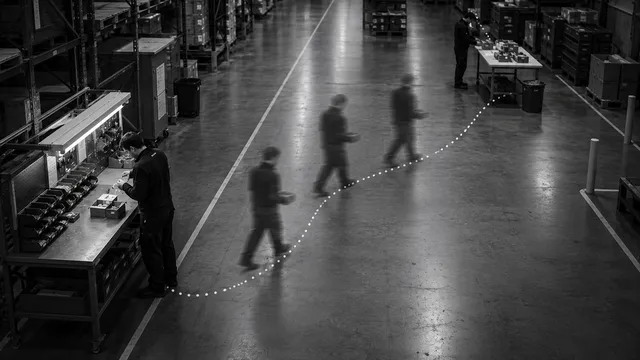
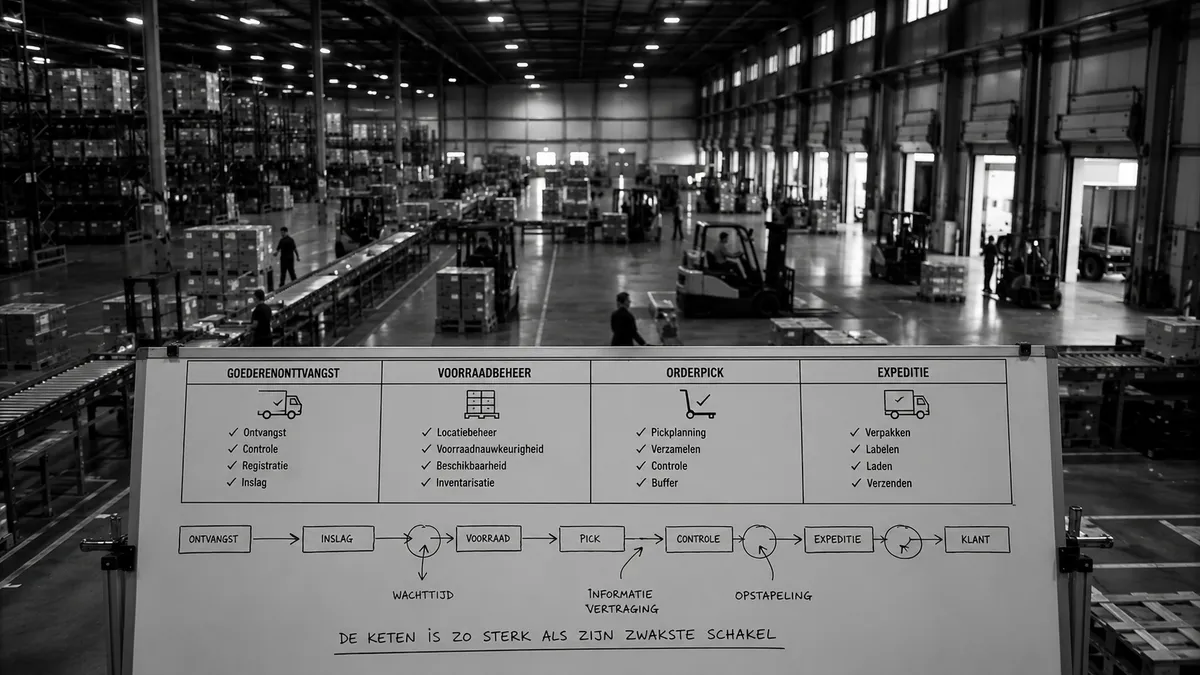
Because an operation ultimately does not consist of separate departments. An operation consists of one continuous flow of goods, information and work that runs through several departments.
It is precisely at the moments when work is handed over from one department to another that the biggest bottlenecks often arise.
An order can only be picked when goods have been correctly received and processed. Production can only start when materials are available. Dispatch can only ship when all preceding steps have been completed successfully.
When one link slows down, it often affects all the processes that follow.
Success on paper, pressure in practice
What stands out is that poor performance is by no means always the issue. In fact, each department is often doing exactly what is expected of it.
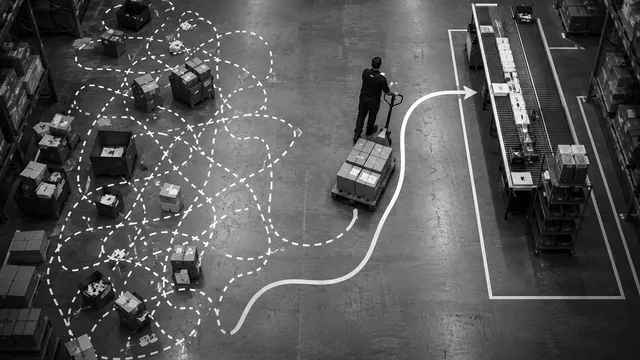
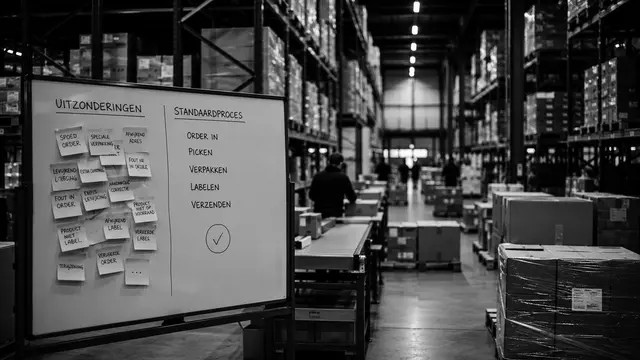
I regularly encounter situations where a department achieves its own targets while creating extra pressure on another department in the process. On paper everything seems to be going well. In the daily operation, however, waiting times, disruptions and extra handling arise that are not visible anywhere in the reports.
This creates a situation in which each department appears successful in isolation, while the total goods flow runs less efficiently than it could.
Vulnerability in a tight labour market
The current labour market makes this question even more important. Many organisations struggle to find experienced order pickers, drivers, planners and technical staff. That makes it increasingly important to handle capacity flexibly.
Yet I still often see processes that depend heavily on specific people or departments. When one employee is absent or the workload unexpectedly increases, a problem arises immediately because the work cannot easily be taken over.
Organisations that make processes understandable and develop employees to be more broadly deployable are often less vulnerable to these situations. Not because everyone has to be able to do everything, but because the operation becomes less dependent on individual links.
Another pattern I regularly encounter is departments having different priorities without this being a conscious choice. One department tries to process as many goods as possible, while another actually needs a steady supply throughout the day. Both departments work hard, but unintentionally steer towards different goals. The result is, for example, peak loads that make it look as if extra equipment is needed.
The consequences often only become visible when the operation is viewed as a whole.
Follow the complete goods flow
That is exactly why a good analysis rarely starts with one department.
The most valuable insights often emerge when the complete goods flow is followed. From the moment goods arrive to the moment they leave the building again.
Only then does it become visible where information gets lost, where work waits unnecessarily and where handovers between departments cause delays. The people who work there every day usually know exactly where it pinches.
The strongest operations I encounter are not necessarily the ones with the most people, the highest speed or the biggest investments. They are often the organisations where departments understand each other, processes connect logically and everyone works towards the same goal.
Because in the end, it is not the quality of an individual department that determines how well an operation performs.
The quality of an operation is determined by how well all departments function together.
Frequently asked questions
Why does an operation underperform when every department hits its targets?
Because an operation is not the sum of separate departments but one continuous flow of goods, information and work. A department that achieves its own targets can unintentionally put extra pressure on the next link in the chain. The waiting times and extra handling this creates are often invisible in the reports.
Where do the biggest bottlenecks in a warehouse arise?
Usually at the moments when work is handed over from one department to another. An order can only be picked, for example, once goods have been correctly received and processed. When one link slows down, it affects all the processes that follow.
How do you improve collaboration between departments in logistics?
By following the complete goods flow instead of looking at each department separately, from the moment goods arrive to the moment they leave the building. Only then does it become visible where information gets lost, where work waits unnecessarily and where handovers cause delays. The strongest operations are not the ones with the most people or the biggest investments, but the organisations where departments understand each other and everyone works towards the same goal.

Sjef Kerkvliet is the founder of OctaFlow and has more than 15 years of experience in intralogistics, warehouse optimisation and internal transport. Drawing on his hands-on experience, he helps organisations with questions around goods flows, process improvement, warehouse layout, automation and operational efficiency.
Want to talk about your operation?
A logistics or operational challenge? OctaFlow is happy to think along. No fuss, just a good conversation.