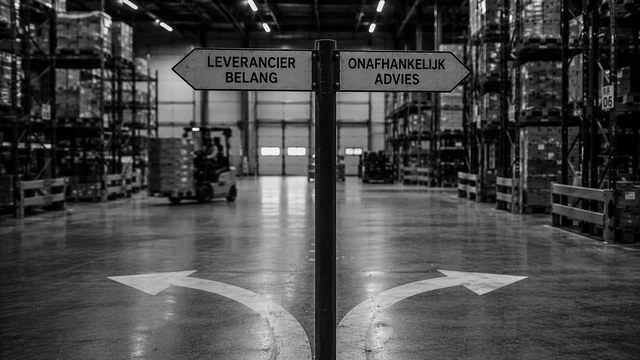

Exceptions exist in virtually every logistics operation. Think of rush orders, deviating customer requests, special packaging or manual corrections. Such situations are simply part of daily practice. No organisation runs entirely according to the standard process, and it does not need to.
Exceptions in logistics processes are deviating situations such as rush orders or special customer requests, which are a normal part of daily practice, but risk drawing too much attention away from managing the standard process.
What regularly strikes me in conversations with managers and supervisors, however, is that exceptions often receive a disproportionately large share of attention. While most of the operation consists of predictable, recurring work, meetings, analyses and improvement programmes are remarkably often about situations that occur only occasionally.
Why exceptions attract all the attention
That is understandable. Exceptions stand out. A deviating order, a customer complaint or a process that unexpectedly stalls draws immediate attention. People want to understand what happened and, above all, prevent the same problem from happening again. That is exactly why exceptions often get far more attention than the daily work that runs smoothly.
The risk is that organisations slowly lose focus on the part of the operation where the greatest result can ultimately be achieved. A warehouse may process thousands of orders a week through a standard process, while a relatively small number of exceptions claims a large share of management attention. This sometimes creates a situation in which a process that supports 98 per cent of the daily work is barely improved, while a lot of time is spent on situations that represent only a fraction of the total operation.
How exceptions make the process complex
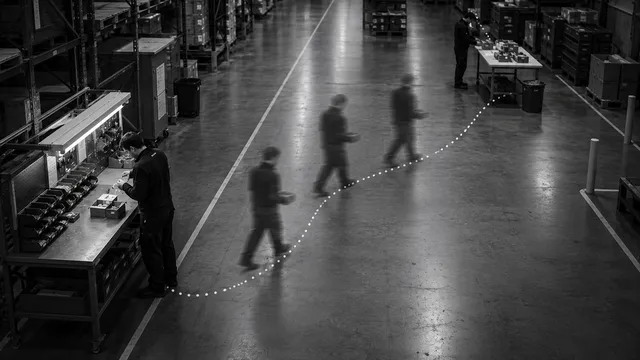
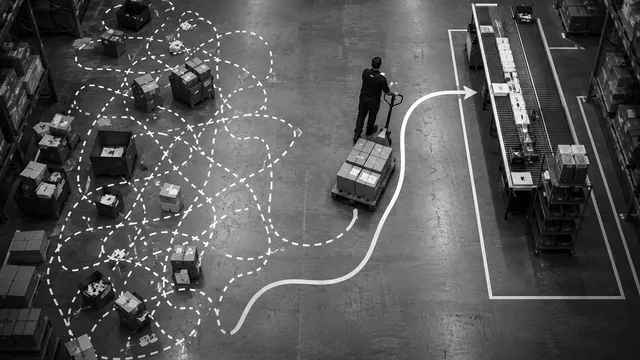
In practice I regularly see processes become more and more complex over the years because exceptions are given a permanent place in the working method. An incident from the past leads to an extra check. A customer complaint results in an additional action. A deviating situation produces a new procedure. In themselves these are often logical decisions, but when this continues for years, a process slowly emerges that is increasingly designed around exceptions rather than around daily reality.
That has consequences for the efficiency of an operation. Employees have to carry out extra steps that are relevant to only a limited number of situations. Processes become harder to explain to new colleagues. Systems contain more and more exception rules and checks. In the end, the standard work is made more complicated to cover a relatively small number of deviations.
The power of the standard process
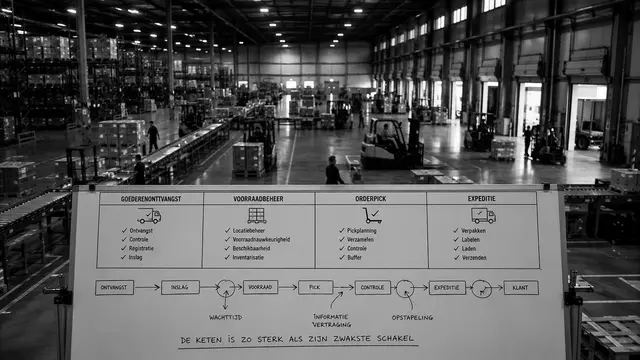
What is often forgotten here is that every improvement to the standard process is applied far more often than an improvement for an exception. When a warehouse performs thousands of actions every day, a small improvement in a standard process can have an enormous impact on an annual basis. A saving of a few seconds per action may seem insignificant, but multiplied across thousands of transactions it often produces a greater effect than fully optimising a rare exception. Many of those small delays are also waste that nobody notices any more.
That does not mean exceptions should be ignored. Some deviations actually point to structural problems that deserve attention. The challenge lies mainly in distinguishing between an incident and a pattern. Not every exception calls for a process change, and not every problem calls for a new procedure. A problem that returns every week, on the other hand, is no longer an incident.
Taking a step back
The strongest organisations I encounter understand this difference. They analyse deviations and incidents, but at the same time keep looking critically at the standard process. That is where most of the work is done. That is where most of the employees are. And that is usually where the greatest improvement potential lies.
So when an organisation notices that a large part of its time is spent on exceptions, it can be valuable to take a step back and look at the operation as a whole again. Not with the question of which exception should be solved next, but with the question of which part of the standard process has the most impact on daily performance.
Because in the end, the success of a warehouse is not determined by the few exceptions that occur each week. It is determined above all by the thousands of actions that are carried out again every day.
Frequently asked questions
Why do exceptions get so much attention in logistics processes?
Exceptions stand out: a rush order, a complaint or a process that stalls draws immediate attention, while work that runs smoothly stays invisible. People want to understand what went wrong and prevent it from happening again. The risk is that the standard process, where most of the work happens, barely gets improved as a result.
Should every exception get its own procedure?
No, not every exception calls for a process change. When every incident leads to an extra check or action, the standard work slowly becomes more complicated over the years to cover situations that rarely occur. The key is distinguishing between an incident and a pattern: a problem that returns every week is no longer an incident and does deserve structural attention.
Where is the biggest improvement potential in a warehouse?
Usually in the standard process, because every improvement there is applied thousands of times a day. Saving a few seconds per action may seem small, but across thousands of transactions it often delivers more than fully optimising a rare exception. So look first at which part of the standard process has the most impact on daily performance.

Sjef Kerkvliet is the founder of OctaFlow and has more than 15 years of experience in intralogistics, warehouse optimisation and internal transport. Drawing on his hands-on experience, he helps organisations with questions around goods flows, process improvement, warehouse layout, automation and operational efficiency.
Want to talk about your operation?
A logistics or operational challenge? OctaFlow is happy to think along. No fuss, just a good conversation.