When organisations look for improvements within their warehouse, attention usually goes to the most visible problems. Damage to goods, incorrect deliveries, idle equipment or system failures stand out immediately. They disrupt the operation, create costs and are usually easy to identify as the cause of a problem.
Hidden waste in a warehouse is time loss that does not show up in reports or dashboards, such as small waiting times and searching that add up daily across multiple employees into a significant cost.
That is exactly why these kinds of topics often receive a lot of attention.
Yet the biggest forms of waste within an operation are by no means always visible. In fact, many of the costs incurred daily barely stand out because they have become part of the normal way of working.
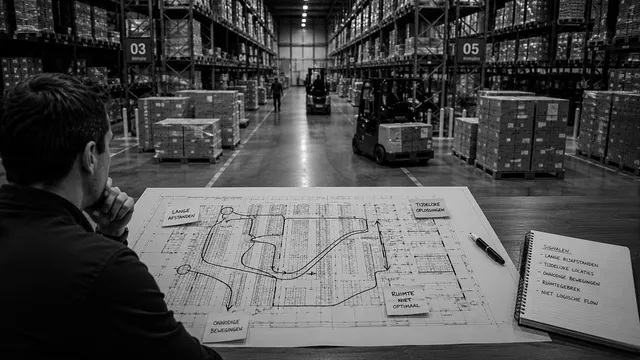
What regularly strikes me during warehouse visits is how much time employees lose on activities that add no direct value. Not because people are not working hard, but because processes, information provision or the layout of the operation slow them down without anyone realising.
Waiting time: small per moment, large per year
A good example is waiting time. In many organisations, employees wait every day for goods, information, systems, colleagues or decisions. It is usually not hours, but short moments spread across the day. That is exactly why they barely stand out. But when dozens of employees lose a few minutes several times a day, this adds up surprisingly quickly on an annual basis.
Searching is not work
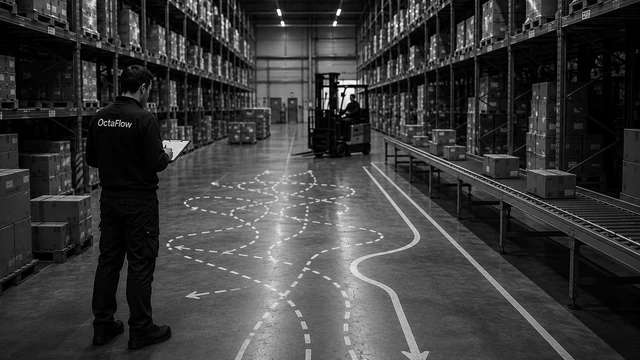
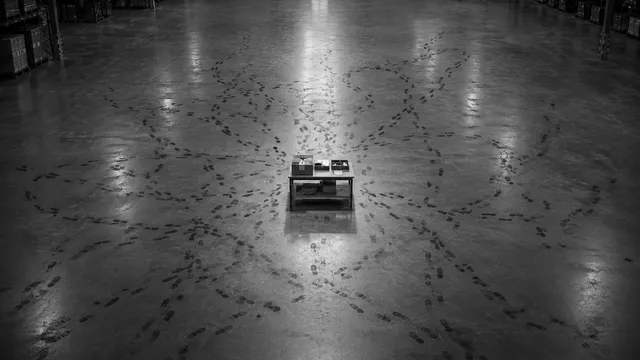
The same applies to searching. In many warehouses, people search daily for pallets, documents, tools, stock locations or information that should be available somewhere. Because this has often become part of the daily routine, it is rarely seen as waste. Yet searching delivers no direct value to the customer, while it does cost time, capacity and attention. It is exactly why a busy warehouse is not automatically an efficient warehouse.
Duplicate work and ambiguity
Duplicate work also occurs more often than many organisations think. Data is entered several times, checks are repeated by different departments and work is redone because earlier steps were not completed fully or correctly. These are often solutions that once arose with the best of intentions, but that over time became part of the process without anyone asking why any more. They often started as a response to an exception that was never reconsidered.
Perhaps the most underestimated form of waste is ambiguity. When employees do not know exactly what the priority is, responsibilities are unclear or departments have different expectations, extra consultation, extra checking and extra coordination arise automatically. On paper everyone seems busy, but part of that effort is only needed because the situation is not organised clearly enough.
The smallest disruptions, the biggest gains
That is exactly why the biggest improvements are not always found in new systems, extra capacity or large investments. The best results regularly come from removing small daily disruptions that have become so normal that nobody notices them any more.
That also makes this form of waste hard to see. A damaged pallet, a broken system or an incorrect delivery stands out immediately. Ten employees losing a few minutes every day to waiting, searching or ambiguity usually do not. Yet the annual impact of the latter is often considerably greater.
The strongest organisations I encounter therefore look not only at what visibly goes wrong. They try instead to gain insight into the activities that take place daily without anyone asking whether they are actually necessary. The people on the shop floor are often the first to recognise that waste. Because that is often where the biggest improvement opportunities lie.
Not all waste shows up in a report or an incident notification. It often hides in the daily routine of an organisation. And it is precisely the waste nobody sees that ultimately tends to cost the most time, energy and money.
Frequently asked questions
What is hidden waste in a warehouse?
Activities that cost time and capacity but add no value and go unnoticed: waiting for goods or information, searching for pallets or tools, duplicate work and extra coordination caused by ambiguity.
Why is hidden waste often bigger than visible waste?
Because it occurs daily and across many employees at once. Ten employees each losing a few minutes a day often cost more on an annual basis than incidental damage or breakdowns.
How do you make hidden waste visible?
By critically observing the daily routine and talking to employees: what are they waiting for, what are they searching for, which work is done twice? An operational quick scan maps these patterns in a structured way.

Sjef Kerkvliet is the founder of OctaFlow and has more than 15 years of experience in intralogistics, warehouse optimisation and internal transport. Drawing on his hands-on experience, he helps organisations with questions around goods flows, process improvement, warehouse layout, automation and operational efficiency.
Want to talk about your operation?
A logistics or operational challenge? OctaFlow is happy to think along. No fuss, just a good conversation.