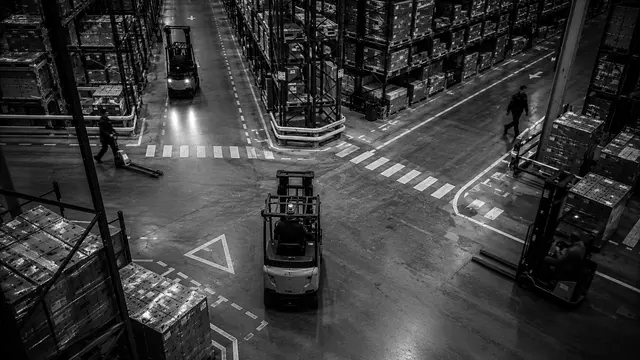
In many warehouses, productivity is regularly linked to speed. The faster a truck drives, the faster goods are moved and the higher the output. On paper, that sounds logical.
Forklift driving speed is not a reliable measure of productivity: the difference between 8 and 12 km/h amounts to mere seconds over a short distance, while wear, energy use and safety risk increase sharply.
Yet reality often turns out to be less straightforward. In practice I regularly see electric pallet trucks set to their maximum speed, with drivers racing through warehouses, loading and unloading zones and staging areas, often convinced that this is necessary to get the work done. The question is whether that extra speed actually delivers that much.
The maths behind top speed
On paper, the difference between 8 km/h and 12 km/h seems considerable, the truck drives 50% faster, after all. That quickly creates the impression that productivity will also rise sharply. But a truck rarely drives at top speed for long: especially around loading docks, the work largely consists of accelerating, braking, steering, positioning and manoeuvring. A driver enters a trailer, picks up a pallet, drives back, finds space in a staging area and repeats this process dozens of times a day. The distance over which maximum speed can actually be reached is therefore often surprisingly limited.
Run the numbers for a few realistic distances within a warehouse:
| Distance | Time at 8 km/h | Time at 12 km/h | Time saved |
|---|---|---|---|
| 10 metres | 4.5 sec | 3.0 sec | 1.5 sec |
| 20 metres | 9.0 sec | 6.0 sec | 3.0 sec |
| 30 metres | 13.5 sec | 9.0 sec | 4.5 sec |
| 50 metres | 22.5 sec | 15.0 sec | 7.5 sec |
Once accelerating, braking and positioning are factored in, that difference becomes even smaller in practice. At a typical distance of 30 metres between trailer and staging location, it quickly comes down to a few seconds per run. Run that across a full day:
If the real time saved per day is limited to a few minutes, what price is being paid for it?
The price of high speed
Higher speeds put more strain on equipment. Wheels wear out faster, chassis take more punishment and dock levellers are loaded more heavily. Anyone who regularly visits warehouses knows the sound of a pallet truck entering a trailer or crossing a dock leveller at high speed, and that sound is not just audible. It is often also a sign that components are being loaded more heavily than necessary, a creeping cost item that belongs in the category of waste nobody sees.
Energy consumption also increases. Batteries are worked harder, need charging more often and can therefore wear out faster, in some cases battery plates are even damaged as the lead filling comes loose. In itself that may seem minor, but on an annual basis the difference can be considerable when an entire fleet is structurally run at higher speeds.
At least as important is the impact on the driver. Anyone who has to accelerate, brake, cross thresholds and ride dock levellers hundreds of times a day faces continuous physical strain. Back, neck, shoulders and knees absorb these forces day after day, an effect that is often underestimated because it is not immediately visible.
Speed as culture
What strikes me is that many drivers genuinely believe they have to work as fast as possible. When you talk to them about it, that expectation often turns out never to have been explicitly stated, it has simply become part of the culture. People see colleagues driving fast and assume that is the norm, new employees copy that behaviour and over time the idea takes hold that speed equals productivity, while that relationship often does not exist. Just as busyness is not the same as efficiency, speed is not the same as output.
Behaviour and technology
The challenge for organisations is therefore not only technical, but above all behavioural: how do you make sure employees understand when speed actually adds value and when it does not? Some organisations opt for training, coaching and awareness. Others use speed limiters or systems that automatically slow vehicles down in specific zones. Which approach works best differs per situation, but what is virtually the same everywhere is that maximum speed does not automatically lead to maximum productivity.
The most important question is therefore not how fast a truck can drive. The more important question is how much value that extra speed actually adds to the operation. Because when the time saved is limited while the risks, wear, energy costs and physical strain increase, driving slower may ultimately prove to be the most efficient choice.
Frequently asked questions
How much time does driving faster really save?
Often just a few seconds per run. Over a typical distance of 30 metres, the theoretical difference between 8 and 12 km/h is minimal, and once accelerating, braking and positioning are included it becomes even smaller.
What are the downsides of high driving speeds in the warehouse?
More wear on wheels, chassis and dock levellers, higher energy consumption and faster battery wear, increased safety risk and continuous physical strain on the driver.
How do you change a culture of driving too fast?
Combine awareness and coaching with technical measures such as speed limiting or zone-based slowing. The key is the conversation about when speed does and does not add value, because the expectation often turns out never to have been made explicit.

Sjef Kerkvliet is the founder of OctaFlow and has more than 15 years of experience in intralogistics, warehouse optimisation and internal transport. Drawing on his hands-on experience, he helps organisations with questions around goods flows, process improvement, warehouse layout, automation and operational efficiency.
Want to talk about your operation?
A logistics or operational challenge? OctaFlow is happy to think along. No fuss, just a good conversation.