In logistics projects, a great deal of time is often spent comparing quotations, negotiating prices and assessing suppliers. Once the signature is in place, the feeling often arises that everything is clear and the project can begin. In practice, however, I regularly see that most discussions only arise after signing.
Contract clarity in an MHE project does not arise automatically once a signature is placed: scope, assumptions and responsibilities need to be made explicit beforehand to prevent surprises during execution.
That is rarely because either party deliberately does something wrong or withholds information. Usually the cause is simpler: both parties think they agreed the same thing, while in reality they have a different picture of what is going to be delivered. And that happens more often than many organisations expect.
Two perspectives, one document
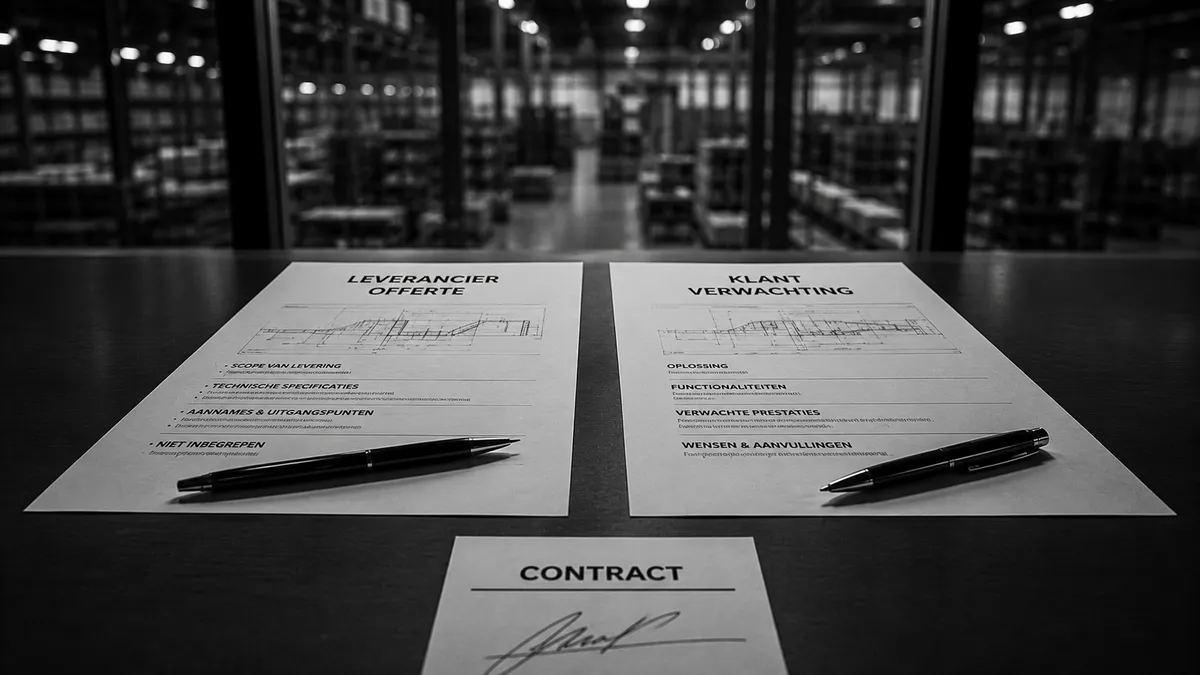
A quotation is rarely read the same way by both parties. A supplier looks at technical specifications, terms and assumptions every day, that is their trade. For the customer, this is usually not daily fare, so terms that are completely clear to the supplier can land slightly differently with the customer. The opposite happens just as often: customers sometimes assume that certain work or provisions are naturally part of the delivery, while the supplier regards them as additional work that was never explicitly agreed.
Are you actually aligned internally? In the free Octagon each role divides 40 points across eight dimensions of an MHE decision separately, and one picture shows you where the priorities diverge.
What is actually "standard"?
I regularly hear the question of what is actually standard. A logical question, but within customised solutions a true standard often does not exist. There are configurations and versions that occur more often than others, but even within those there are usually several variants, depending on the specific situation and the wishes of the user. What is standard for one organisation can be a deviating version for another. More important than discussing what seems standard is therefore establishing what is actually part of the agreed delivery, because otherwise these differences only surface during execution.
When the price absorbs all the attention
During negotiations, attention often shifts to the price, and that is understandable: investments are considerable and everyone wants a good deal. Yet I regularly see the discussion about a few per cent discount get more attention than the content of the quotation itself, while that is exactly where later surprises arise. Not because the price was wrong, but because what falls inside and outside the scope of the delivery was not discussed sufficiently.
Logistics operations are also often more complex than they appear on paper. During preparation everything seems clear, but implementation reveals that processes run differently than expected, that a software interface is missing, that existing infrastructure needs adapting, or that operational conditions deviate from the original assumptions. At that point the question quickly arises of who is responsible for the extra work or costs, not because someone is deliberately doing something wrong, but because the translation between the quotation and the daily operation was not made sufficiently. Everyone understands their own part of the project, but not always the full picture.
A framework agreement makes this considerably harder
A one-off purchase is already difficult enough. A framework agreement with a supplier adds an extra layer on top of that. Take a global contract for your equipment: you inevitably end up dealing with multiple parties at once. The local dealer carrying out maintenance is not automatically the same party supplying accessories, and the reporting you want to see centrally often comes from a different system than the one invoicing runs through.
What looks like a single agreement with a single supplier on paper therefore quickly turns out, in practice, to be a chain of parties that each apply their own interpretation of that same agreement. Terms that are clearly defined centrally are sometimes carried out differently locally. Service levels that appear identical worldwide differ in practice by country or region. And if reporting and invoicing are not set up the same way, you lose exactly the overview the framework agreement was meant to give you.
The larger and more international the contract, the more important it becomes to test in advance how the agreements relate to local execution, not only to the central terms on paper.
Start with shared understanding
A good quotation therefore does not start with the price or the technical specifications, but with a shared understanding of the problem to be solved and the situation in which the solution will have to function. The same principle applies to drawing up a good tender. The better the operational need is defined in advance, the easier it becomes to genuinely compare quotations: when it is clear to all parties which performance, functionalities and preconditions are needed, there is less room for differing interpretations during execution.
Strikingly, that is often when more room emerges for healthy negotiation. Not because the price is scrutinised less critically, but because there is more certainty in advance about what will actually be delivered. The discussion then shifts from assumptions to the content and the commercial terms of the offer.
That does not mean every change or extra cost item can be prevented. In complex projects, and certainly in international framework agreements, situations will always arise that were not fully visible in advance. It does mean that many discussions can be prevented by paying more attention in advance to the content and less to the assumptions. A signature is not proof that everything is clear, it is the moment at which both parties confirm that they think everything is clear. And that is sometimes exactly where the difference lies.
Frequently asked questions
Why do discussions often only arise after a contract has been signed?
Most discussions arise because both parties think they agreed the same thing, while in reality they have a different picture of what is going to be delivered. A supplier reads a quotation through technical specifications and terms, while the customer sometimes assumes certain work is included even though it was never explicitly stated. These differing interpretations usually only come to light during execution.
What counts as standard in an MHE quotation?
Within customised solutions, a true standard often does not exist. What is a standard solution for one organisation can be a deviating version for another. So discuss not only what seems standard, but above all what is actually part of the agreed delivery.
How do you prevent discussions about extra work in a logistics project?
By defining in advance exactly what falls inside and outside the scope of the delivery, rather than focusing all attention on the price. The better the operational need is described up front, the less room there is for differing interpretations during execution. Not every change or extra cost can be prevented, but many discussions can.
Why is an MHE framework agreement more difficult than a single contract?
Because a framework agreement, especially a global one, inevitably involves multiple parties at once: service, accessories, reporting and invoicing often run through different parties or systems. Agreements that are clear centrally are sometimes carried out differently locally, which can cost you exactly the overview you entered the agreement to gain.

Sjef Kerkvliet is the founder of OctaFlow and has more than 15 years of experience in intralogistics, warehouse optimisation and internal transport. Drawing on his hands-on experience, he helps organisations with questions around goods flows, process improvement, warehouse layout, automation and operational efficiency.
Want to talk about your operation?
A logistics or operational challenge? OctaFlow is happy to think along. No fuss, just a good conversation.