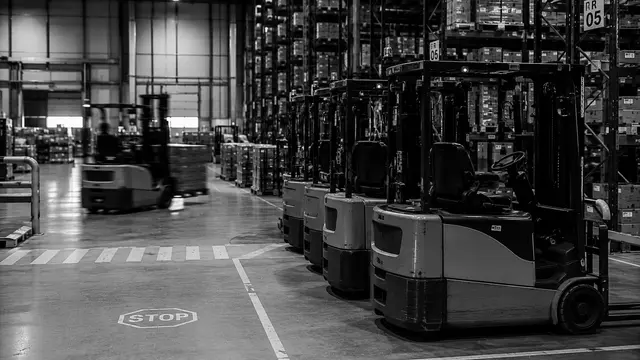

When pressure in a warehouse increases, the same question sooner or later ends up on the table. Are there enough forklifts available to do the work?
The number of forklifts a warehouse needs is not determined by how busy it feels, but by the actual utilisation of existing equipment and how the process is organised.
In many organisations that question is answered based on gut feeling. Drivers experience busyness, departments indicate that there is a shortage of equipment and the utilisation rate seems high. The logical conclusion is then often that extra trucks are needed.
Yet I notice that reality is regularly more complex.
More driving hours do not automatically mean more productivity
What strikes me here is that many organisations look at the use of a truck, but not always at the way that truck is used.
A truck that clocks many running hours seems well utilised at first glance. In practice, however, that says far from everything.
I once experienced a situation, for example, where an electric pallet truck clocked a remarkable number of driving hours, while the number of lifting hours remained relatively low. On paper the truck seemed to be used intensively. The first thought might then be that this truck makes an important contribution to the operation.
When we looked more closely at the usage pattern, something striking emerged. Employees regularly used the pallet truck to move around the distribution centre. The toilets were on the other side of the building and the truck was used to travel back and forth more quickly.
From the employee's perspective that was entirely understandable. It saved time and made the work easier. At the same time, such an example shows how important it is to look beyond usage hours alone.
That particular pallet truck represented a value of around fifteen thousand euros. When part of its use consists of transporting employees through the building, the question naturally arises whether this is really the most effective deployment of the equipment. After all, for that amount you could also buy quite a few bicycles or scooters.
Busyness does not automatically mean a shortage
I regularly see the same thing in discussions about fleet expansion. A warehouse can be busy without there actually being a shortage of equipment.
When drivers have to wait a lot, cover unnecessarily long distances or regularly carry out extra movements, the impression quickly arises that extra trucks are necessary. In reality the cause then often lies somewhere else in the process.
That does not mean expanding the fleet is never needed. But I regularly see that organisations look at extra equipment first before investigating how the existing equipment is actually being deployed.
Utilisation is often more important than numbers
The question of how many forklifts an organisation needs therefore does not start with the number of trucks present. Far more interesting is the question of how much of that capacity is actually used for work that adds value to the operation.
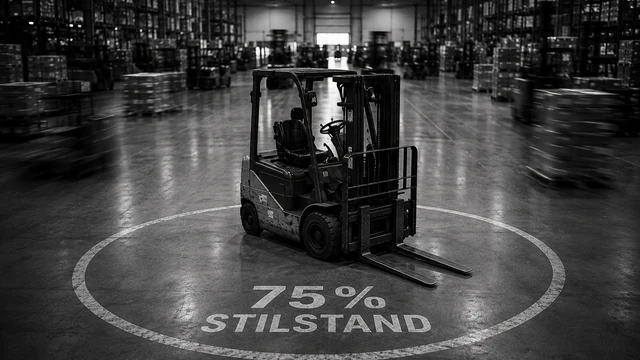
I regularly come across situations where trucks appear active for much of the day, while a considerable part of the time is spent waiting, searching, taking detours or carrying out transport movements that could actually have been avoided.
On paper the utilisation seems high. In practice part of the capacity turns out to be lost in processes that are not optimally organised.
It is precisely because of this that a shortage of equipment can sometimes be experienced while in reality there is a shortage of efficiency.
Understand first, then expand
What I often see in practice is that organisations wonder how many trucks they need, while the more important question is actually why the current fleet does not seem to be enough.
Where are the most metres driven? Which transport movements actually add value? How much time is spent waiting, searching or taking detours? And are the goods flows still aligned with the current operation?
It is precisely by answering these questions that a much better picture of the actual capacity requirement emerges.
Sometimes that leads to the conclusion that expansion is necessary. Regularly, however, it turns out that the existing fleet offers more possibilities than previously thought.
More than a calculation
The question of how many forklifts a warehouse needs can rarely be answered with a simple formula.
The required fleet depends on goods flows, distances, peak load, shift patterns, warehouse layout and the way processes are organised. As a result, two warehouses with comparable volumes can have a completely different capacity requirement.
The discussion is therefore not only about the number of trucks. Ultimately it is about the question of how internal transport can be organised so that the available capacity is used optimally.
And that is exactly why answering this question usually does not start with the forklift, but with the process.
Frequently asked questions
How do you determine how many forklifts a warehouse needs?
It depends on factors such as transport distances, goods flows, shift patterns, peak load and the efficiency of existing processes. That is why an analysis of the operation is often necessary.
Does a high utilisation rate mean a truck is used efficiently?
Not always. A truck can run many hours without those hours actually contributing to productive work. That is why it is important to look not only at usage hours, but also at the type of activities being carried out.
When is expanding the fleet sensible?
When analysis shows that the existing capacity is being used efficiently and does not offer enough room to absorb operational demand. Only then does it become clear whether extra equipment is actually necessary.

Sjef Kerkvliet is the founder of OctaFlow and has more than 15 years of experience in intralogistics, warehouse optimisation and internal transport. Drawing on his hands-on experience, he helps organisations with questions around goods flows, process improvement, warehouse layout, automation and operational efficiency.
Want to talk about your operation?
A logistics or operational challenge? OctaFlow is happy to think along. No fuss, just a good conversation.