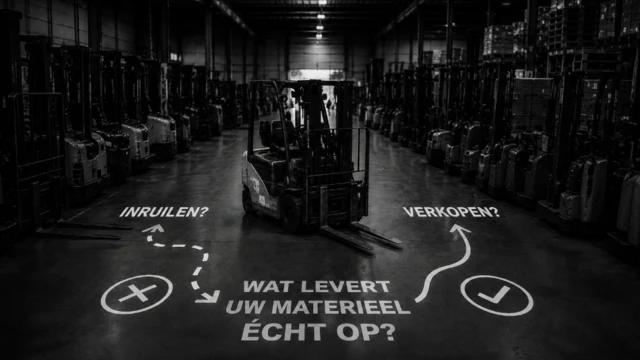

When material handling equipment is no longer needed, attention usually goes to the practical moment a machine leaves the operation. That doesn't automatically achieve the best financial outcome.
A machine can be operationally redundant while still representing an interesting value on the market. Conversely, waiting too long to divest can lead to further value decline, extra maintenance, or a bigger write-off than necessary.
OctaFlow supports organisations in strategically winding down, relocating and divesting material handling equipment. We look at current usability, market value, remaining useful life, timing and possible sales channels.
The starting point is not to get rid of a machine as quickly as possible, but to determine when, how, and through which channel equipment can best be relocated or sold.
When is strategic divestment worthwhile?
Divesting or relocating equipment becomes relevant when an organisation wants to shrink, renew or reshape its fleet. That can apply, for example, when:
- machines are structurally under-used;
- a new fleet is being purchased;
- several machines need replacing at the same time;
- a site is closing or expanding;
- activities are being divested or relocated;
- operational needs are changing;
- equipment no longer fits current work;
- more similar machines are available than necessary;
- lease contracts or rental periods are expiring;
- machines are still technically fine but no longer operationally needed;
- an organisation wants to lower the average age of its fleet;
- surplus equipment is spread across multiple locations.
Even when an organisation only wants to replace part of its fleet, it can be wise to first look at the total equipment base. The question then isn't only which machines to replace, but also: which machines will still be needed afterwards, which could be used elsewhere, and which are better divested?
What does OctaFlow examine?
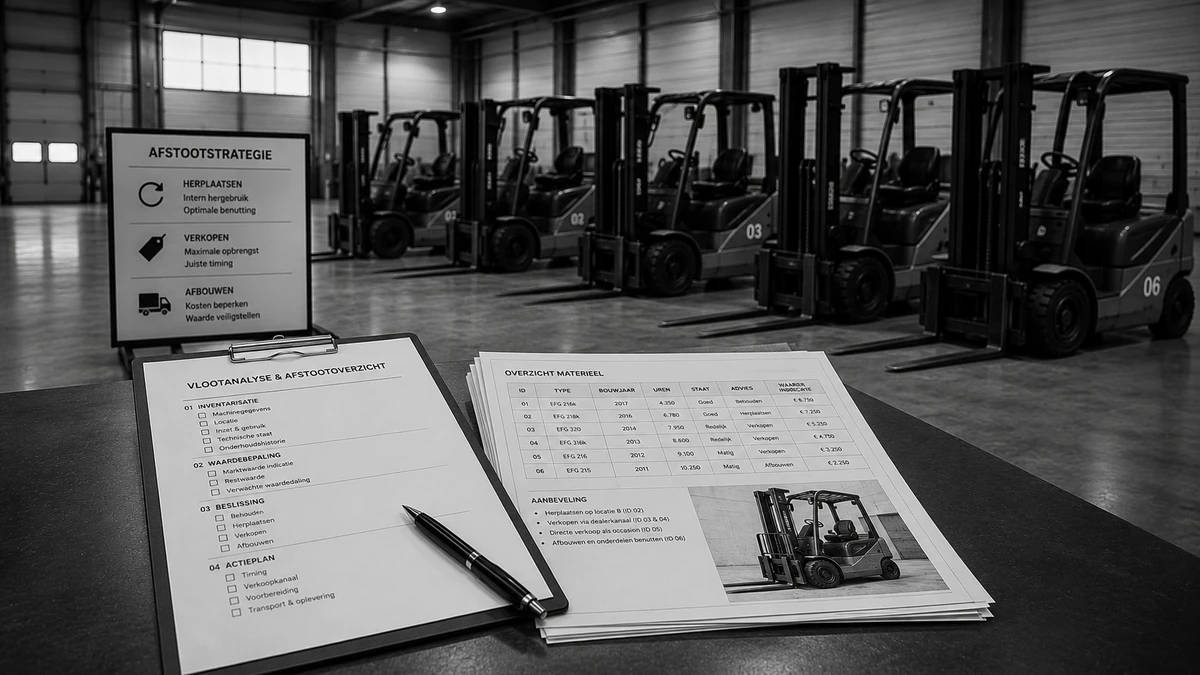
A good fleet wind-down starts with insight into the machines actually available and the value they represent.
Current fleet
We map what equipment is present, where it's deployed, and what role each machine plays within the operation.
Technical and operational condition
We look at age, operating hours, maintenance history, technical condition, specification and remaining usability.
Market value
The original purchase price is not the same as current market value. We distinguish between book value, economic value and market price.
Timing
The moment of divestment can influence the eventual outcome. The optimal timing depends on use, value development and future need.
Relocation options
A machine no longer needed at one location may still be valuable at another.
Sales channel
Depending on machine type, condition, quantities and desired speed, options can include direct sale, trade, or specialised sales channels.
How does a divestment and relocation project work?
-
Determining future need
Before equipment is divested, it needs to be clear what capacity the organisation actually needs. We therefore start by looking at the future fleet and operation, preventing machines being sold that later turn out to be needed again.
-
Identifying surplus equipment
Next, we determine which machines are no longer necessary for the future operation, looking not only at age or book value but especially at actual operational need. A relatively young machine can be surplus, for example, while an older machine should be kept for a specific role.
-
Determining value and sellability
For equipment that can genuinely be divested, we assess its current market position, taking type, specification, age, operating hours, technical condition and current market demand into account, giving a realistic basis for the next step.
-
Deciding relocation or sale
For each machine, we then assess the most logical route: internal relocation, direct sale, sale through a specialised channel, or another form of disposal, weighing proceeds, speed, effort and risk.
-
Preparing equipment for sale
When sale is chosen, we determine what preparation makes sense: technical inspection, maintenance, documentation, photos, specifications and gathering relevant machine data. Not every pre-sale investment automatically adds more value, so we assess per machine which preparation is genuinely worthwhile.
-
Guiding sale and wind-down
Where desired, OctaFlow can support the sale and wind-down process, helping compare bids, assess sales proposals and monitor the agreed starting points. The goal is a controlled wind-down where it's clear which equipment is disposed of when and through which route.
Not every surplus machine should be sold
A machine that has become redundant at one location isn't automatically economically written off. When the same machine is still needed elsewhere in the organisation, internal relocation can be more attractive than selling it and buying a new machine. That's why total fleet need should be examined first.
This is especially relevant for organisations with multiple locations or different operational profiles. A machine that offers insufficient capacity in a demanding distribution environment can, for example, still function perfectly well at another site.
Divestment therefore starts with the question of whether the machine is genuinely redundant.
The right moment to divest
The value of material handling equipment changes over its lifetime. In the early years, a machine can still be relatively attractive on the second-hand market. As age, operating hours and maintenance needs increase, market value can decline further.
At the same time, a machine represents value to the organisation itself for as long as it's operationally deployed. That's why the optimal divestment moment isn't simply when a machine reaches a certain age. It's about the balance between current operational value, expected future deployment, market value, maintenance and reliability, expected value decline, and future fleet need.
The best sale is not always the fastest sale.
What does strategic divestment deliver?
A controlled wind-down of equipment can help organisations better match their fleet to actual need. Depending on the situation, this can lead to:
- a smaller, better-matched fleet;
- less unused equipment;
- better use of remaining machines;
- higher sale proceeds;
- less unnecessary maintenance and operating cost;
- better-timed replacement;
- more insight into the value of the existing fleet;
- a controlled transition to new machines;
- less capital unnecessarily tied up in surplus equipment.
The goal is not to sell as many machines as possible. The goal is to keep the right machines and wind down surplus equipment at the right time, through the right channel.
Checking the trade-in offer
When equipment is replaced, an organisation almost always receives an offer for what is going out, from the supplier delivering the new machines. That offer is rarely made in bad faith, but it is the only figure on the table, and it comes from the party that will resell the machine afterwards.
That creates a situation that would be unacceptable in any other purchasing process: the only party who knows the second-hand market is the party making the offer. There is no reference and no way to check whether the amount is right. It gets accepted because there is nothing beside it.
OctaFlow puts something beside it. A second price is obtained on the same equipment, from several dealers who know they are not the only ones bidding. That price goes next to the supplier's offer, and the client decides. If it is higher, that difference is a direct result.
The same method as a tender, in reverse
This approach is not new within OctaFlow. In a purchasing process we make suppliers bid against each other so an organisation does not overpay. When disposing of equipment, exactly the same thing happens in the other direction: buyers bid against each other so an organisation does not receive too little.
Same starting point, same independence, same reason. A price that comes about without competition is not a market price but a proposal.
What is asked of the client
Checking starts with a proper file. For each machine the specifications, the condition and the known faults are recorded, with photos. That is where the whole value sits: a dealer who can see everything bids on the machine that is there, while a dealer who has to guess prices in the disappointment. That difference goes straight to the owner.
Registering takes about five minutes per machine and is done through the Residual Value Check on this site. Several machines at once is no problem. Dealers get three working days to respond; within five working days the result follows with one amount per machine, excluding VAT and including collection by the buyer.
There are no costs involved and no obligation to do anything with the result. Until an offer is accepted, a client remains free to sell elsewhere, including to their own supplier.
Start the Residual Value Check →
What does OctaFlow deliberately not do?
OctaFlow doesn't automatically advise selling old equipment as fast as possible. A machine can still have an important operational role despite its age. It can also be financially more attractive to relocate a machine internally than to sell it at a relatively low market value.
A machine's value is also not determined solely by what a trader is willing to pay. The economic value to the organisation itself and the possible value on the external market can differ significantly.
That's why we first establish what role a machine still has, and only then how it might eventually be divested.
Finally, OctaFlow is open about its own role in checking a trade-in offer. The value is not in requesting a few bids, but in knowing which buyer belongs with which machine. A clean three year old electric forklift, a reach truck with a damaged mast and a sweeper that can go abroad end up with three different parties, and that difference is larger than the negotiation. Depending on that route, OctaFlow acts as a broker, or buys the machine itself and moves it on to the buyer it belongs with. That is stated in advance. The client compares two amounts and takes the highest, with their own supplier's offer as the reference. The advice on which machines the operation still needs is deliberately kept separate from that and delivered on its own.
When is strategic divestment not the right step?
When an organisation doesn't yet have a clear picture of future fleet need, it's often too early to divest equipment. In that case, fleet optimisation may be needed first to determine how many machines, and which types, are actually needed.
Also, when equipment is technically or economically worth keeping, selling may not be the best solution.
In a larger fleet renewal, both projects can come together well: first determine what future fleet is needed, then wind down surplus equipment in a controlled way.
What does a divestment and relocation project cost?
The scope of a project depends on the number of machines, locations, desired support and the chosen sales or relocation strategy. An organisation looking to divest a few machines requires a different approach than a complete fleet wind-down involving dozens of machines assessed and disposed of through different channels.
That is why OctaFlow does not work with a single standard price. After an intro call, we determine what support is needed and what investment it requires.
Frequently asked questions
When is it worth selling a forklift?
That depends on future operational need, technical condition, market value, maintenance cost and expected value decline. Selling a forklift simply because it has reached a certain age is therefore not automatically the best choice.
How do you determine the value of a used forklift?
Brand, type, age, operating hours, specification, technical condition, maintenance history and current market demand all determine value. A distinction should be made between book value, economic value and actual market value.
Is internal relocation better than selling?
It can be. When a machine still fits the work well at a different location, internal relocation can be economically more attractive than selling and replacing it. This needs to be assessed from the perspective of the total fleet and future need.
How do I sell surplus forklifts?
That can be done through various channels, depending on equipment type, condition, quantities and desired speed. The right sales route is determined by expected proceeds, market reach, required effort and risk.
Is it wise to have a forklift serviced before selling it?
Not always. Some investments in maintenance or cosmetic improvement can increase sellability, while others barely show up in the final sale price. It's therefore worth determining in advance which preparation actually adds value.
Can OctaFlow help sell a complete forklift fleet?
Yes. For larger wind-down projects, OctaFlow can support determining which machines should be kept, relocated or divested, and organising the follow-up steps.
Can OctaFlow also help when I want to replace my entire fleet?
Yes. In that case, fleet optimisation and strategic divestment can be combined. First we determine what future fleet is needed. Then we assess which existing machines can be kept, relocated or sold, and how the transition can be organised in practice.
Does this not make OctaFlow a dealer?
The difference is in the assignment. A dealer makes one offer and has an interest in a low price. OctaFlow works for the owner and has an interest in a high price, because that is where the difference with the existing offer is paid from. The work is in finding the buyer who needs this particular machine most, and that is not the same party for every machine. Depending on that route, OctaFlow brokers the deal or buys the machine itself and moves it on. That is stated in advance, and the supplier's own offer always remains the reference.
Do dealers see my company name?
No. The file that goes to the market contains the specifications, the condition and the photos, but no company name, address, contact details or serial numbers. Those stay with OctaFlow.
Why do I have to include photos?
Because a dealer does not bid on a description alone. Without images he covers himself against what he cannot see, and that costs the owner money. Three overview photos are the minimum, plus the hour meter and the data plate, because running hours and configuration have the strongest effect on value.
From surplus equipment to a controlled fleet
A healthy fleet doesn't consist of as many machines as possible, but of the machines the organisation actually needs. OctaFlow helps organisations wind down equipment strategically: independently, with solid evidence, and with an eye for both operational need and the value of the existing fleet.