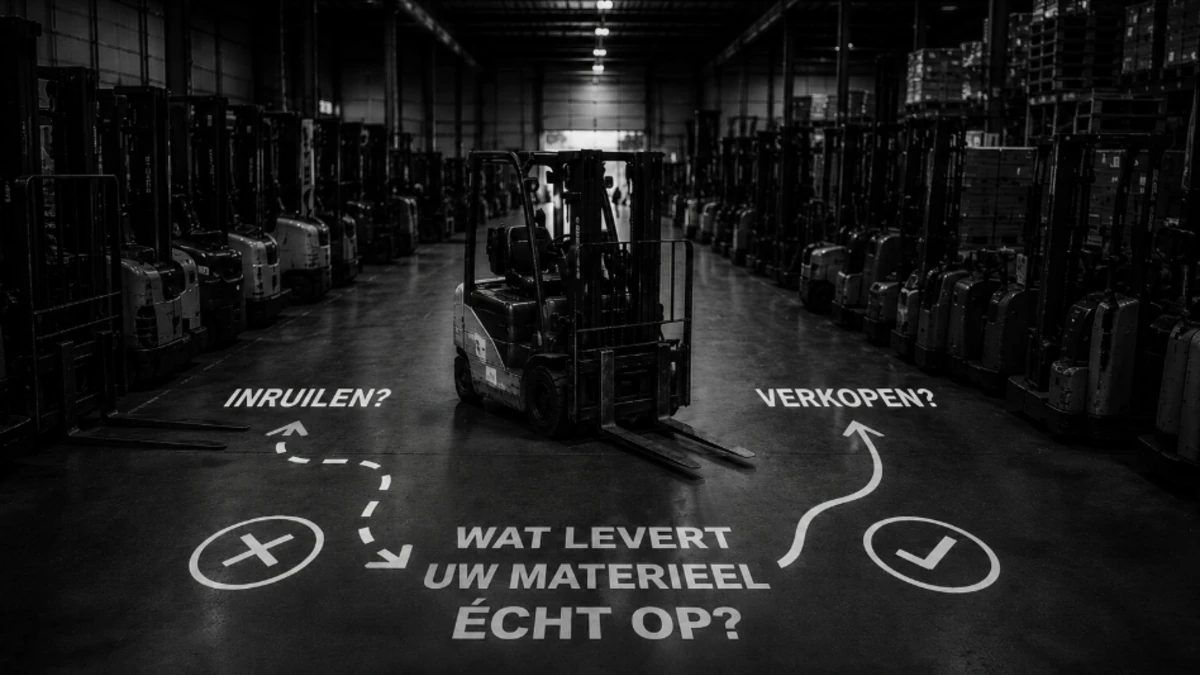
Struggling to decide between trading in or selling your used forklifts, reach trucks or other material handling equipment? You are not alone. Many organisations automatically choose to trade in with the supplier of the new machines. That is simple, straightforward and takes little extra time.
Residual value of used material handling equipment is the market value a used forklift, reach truck or other equipment still represents, determined by factors such as brand, year of manufacture, operating hours, maintenance history and current demand in the second-hand market, not by a fixed price list.
But does that route actually deliver the highest return? Not always.
Especially during a fleet renewal, the focus tends to be on purchasing new equipment. The price of the new forklifts gets negotiated hard, lease terms are compared and service contracts are discussed. The value of the existing equipment gets remarkably little attention.
And that's a shame. Because that's exactly where a significant financial advantage can be hiding.
Whether you are leaving that advantage on the table takes one step to find out: put a second price next to your supplier's offer, straight from the market. That is what the Residual Value Check is for, free and with no obligation. First, below, where that value comes from and why one offer rarely tells the whole story.
Selling or trading in a forklift: what's the difference?
When you choose to trade in, the supplier takes over your existing machines as part of the overall deal. That's practical and gives you a single point of contact.
Yet it's difficult to judge exactly how good that deal really is.
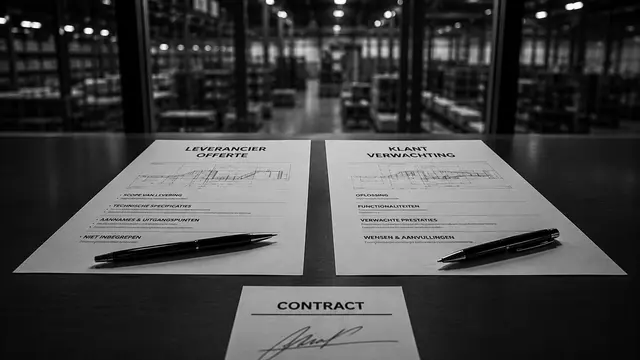
The trade-in value is rarely assessed on its own. It's usually part of a broader negotiation that also includes the purchase price of new machines, maintenance, lease, service and financing.
That raises a logical question: are you actually getting a high trade-in value, or is it being offset by a higher purchase price for the new equipment?
The opposite happens just as often. An attractive purchase price can come with a lower valuation of your existing machines.
The more variables are part of a single negotiation, the harder it becomes to objectively compare different offers.
What is a used forklift actually worth?
There is no fixed price list for used forklifts or other material handling equipment. The eventual market value is determined by a combination of technical, commercial and economic factors.
Among others, the following aspects play an important role:
- brand and model
- year of manufacture
- operating hours
- maintenance history
- technical condition
- battery condition
- mast configuration
- lifting capacity
- tyres
- cab or options
- current market demand
- demand from export markets
That's exactly why the same machine can represent a completely different value for different parties.
The market is bigger than one supplier
Many organisations automatically see the supplier of the new equipment as the party that also takes over the old equipment.
That's understandable. But the second-hand market is considerably bigger.
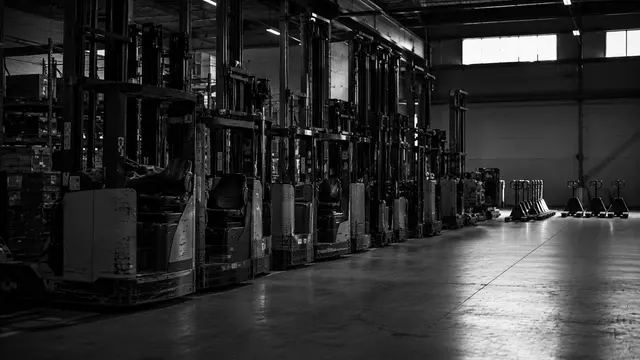
Used machines find their way to logistics service providers, manufacturing companies, dealers, rental companies and international buyers. What is economically written off for one organisation can still be excellently usable for years for another.
Approaching the market more broadly often results in a more realistic picture of the actual value.
Which used equipment is interesting for the second-hand market?
The question is no longer limited to forklifts. The following machines are also regularly sold or traded internationally:
- forklifts
- reach trucks
- electric pallet trucks
- order pickers
- very narrow aisle trucks
- terminal tractors
- tractor units
- AGVs
- AMRs
- aerial work platforms
- sweepers
- scrubbers
- traction batteries
- chargers
- attachments
- other rolling material handling equipment
For many of these machines there is an active second-hand market, both within the Netherlands and internationally.
When is trading in actually a good choice?
That is sometimes forgotten. Trading in is certainly not a wrong decision by definition.
When the price offered is in line with the market, and speed or simplicity matter more than maximum return, trading in can be an excellent solution.
The most important thing, therefore, is not whether you trade in, but that you know what your equipment is actually worth before making a final decision. An independent valuation lets you decide with confidence.
And that does not have to become a project. You only need to know what the market gives for it today, before you sign.
Know what it is worth before you sign. Register your machines and we will collect a second price from the market. Within five working days you know where you stand.
How to find out what the market gives
OctaFlow represents no manufacturer and is not tied to a single buyer. That means I can independently assess which route delivers the most for your situation.
That is what the Residual Value Check is for. You fill in what you have standing, we put that out as one tidy file to several parties who bid against each other, and within five working days you hear what the market gives for it.
- You fill it in. Allow about five minutes per machine, easy enough on your phone while you are standing next to it. Data plate, hour meter, a few photos. Loose traction batteries, chargers and attachments are welcome too.
- We put it out. Not to one dealer, but to the parties waiting for this particular kind of machine. Sometimes someone who already has a customer for it, sometimes an end user looking for exactly this machine. That buyer pays the best price.
- You compare. You put our figure next to the trade-in offer you already had and take the highest. If your own offer comes out higher, you now know it was a good offer. That is a result too.
It costs you nothing and commits you to nothing. You keep your own offer alongside it and decide for yourself. Does your current solution turn out to be the best? Then nothing changes, except that you now know it for certain.
In short
When purchasing new material handling equipment, the price of the new machines is often negotiated hard. Just as important, however, is the value of the equipment your organisation leaves behind.
An independent assessment of that residual value creates more transparency, a fairer comparison between offers and, in many cases, a stronger negotiating position.
Sell your used equipment. But not before you know what it is worth.
Five minutes per machine, and you know. Fill in what you have standing. We collect the prices, you compare and choose. Free, and you are committed to nothing.
Frequently asked questions
Is selling a forklift better than trading it in?
It depends on the situation. Trading in offers convenience, while an independent sale can deliver a higher return in some cases. An objective comparison gives insight into both options. The Residual Value Check puts that comparison next to your trade-in offer, free of charge.
How do you determine the residual value of a used forklift?
The value is determined by factors including the brand, year of manufacture, operating hours, maintenance, technical condition, configuration and current market demand.
Can I sell multiple used forklifts at once?
Yes. Both individual machines and entire fleets can be sold. For larger quantities, a structured market approach is often particularly worthwhile.
What does an independent valuation cost?
Nothing. OctaFlow's Residual Value Check is free and without obligation. You register your machines, we collect a second price from the market, and you compare it with the offer you already had. You are committed to nothing.
Does this only apply to forklifts?
No. Reach trucks, pallet trucks, order pickers, AGVs, AMRs, aerial work platforms, scrubbers, sweepers, traction batteries and other material handling equipment can also be independently assessed.

Sjef Kerkvliet is the founder of OctaFlow and has more than 15 years of experience in intralogistics, warehouse optimisation and internal transport. Drawing on his hands-on experience, he helps organisations with questions around goods flows, process improvement, warehouse layout, automation and operational efficiency.
Want to talk about your operation?
A logistics or operational challenge? OctaFlow is happy to think along. No fuss, just a good conversation.