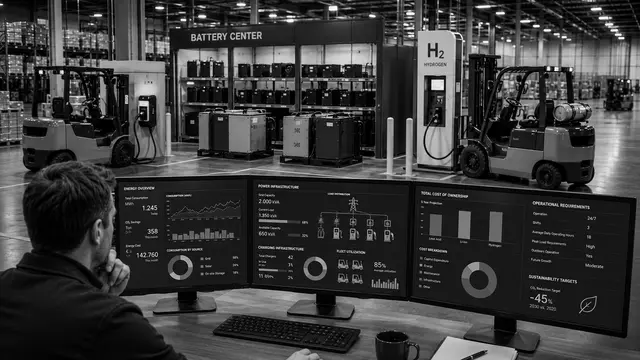

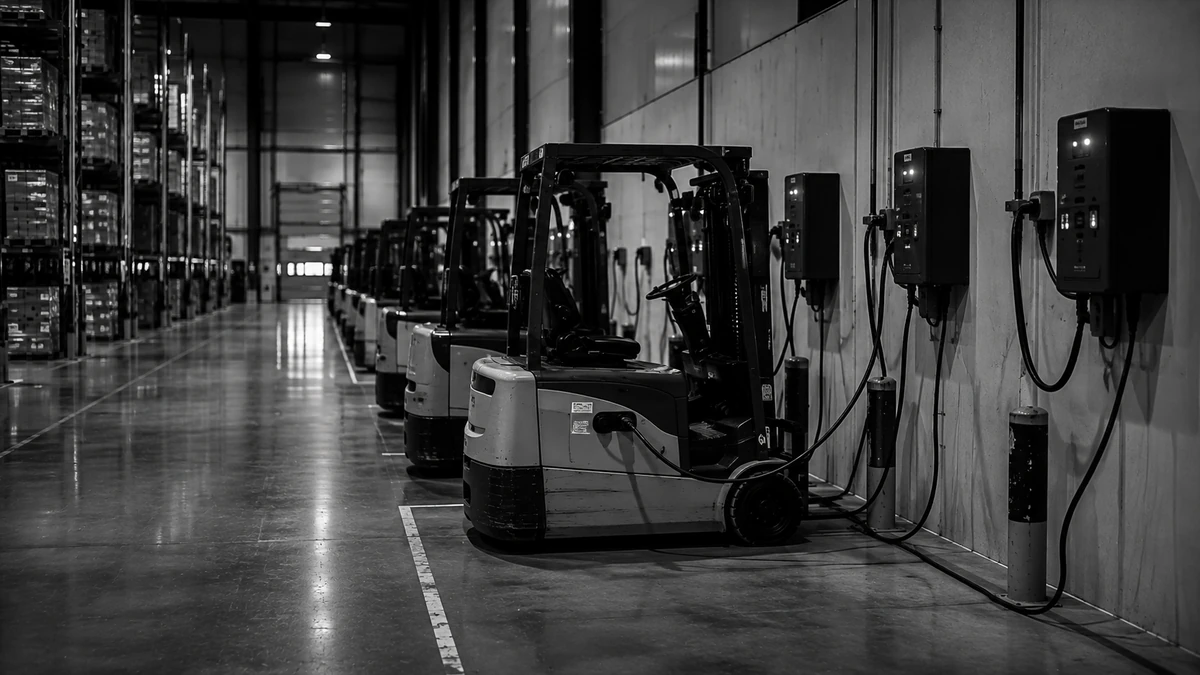
The choice of power source for material handling equipment has a direct impact on cost, availability, infrastructure and the way a logistics operation can function in the future.
Switching from diesel or gas to electric drive can look, at first glance, mainly like a choice of a different machine. In practice, much more often changes. Charging times, charging locations, energy use, shift patterns, grid capacity, infrastructure and machine usage profiles together determine whether a particular power source is actually suitable.
OctaFlow helps organisations make these choices independently and with solid evidence. We look not only at a machine's purchase price, but at the full operational picture and cost over the usage period.
Depending on the application, we examine diesel, LPG, lead-acid, lithium-ion and other available drivetrain technologies. Where alternatives such as hydrogen are relevant, these are included in the assessment too.
The goal is not to choose a particular power source in advance, but to establish which solution best fits the organisation technically, operationally and financially.
When is power source advice worthwhile?
Choosing a different power source becomes relevant when existing machines are due for replacement, the organisation wants to become more sustainable, or the current power supply no longer fits the operation well. That can play out, for example, when:
- existing diesel or gas machines need replacing;
- the organisation wants to switch to electric forklifts;
- it's unclear whether lithium-ion or lead-acid fits best;
- multiple shifts run with the same equipment;
- charging options are limited;
- available grid capacity starts to play a role;
- the energy cost of internal transport is rising;
- existing energy infrastructure needs to be adapted;
- the organisation wants to substantiate sustainability investments;
- new machines are being purchased and the power source needs to be reconsidered;
- there are plans to expand the site;
- future energy needs are not yet sufficiently clear.
Even when an organisation has no problem with its available power supply today, it can be wise to look ahead.
A fleet that is gradually being electrified can have a significantly different electricity demand a few years from now than the current operation. The right choice is therefore not only about what works today, but also about what remains workable and affordable tomorrow.
Which power sources can OctaFlow assess?
Not every power source suits every application. The right choice is determined by the combination of machine, usage profile, infrastructure and operational conditions.
| Power source | Strong for | Main consideration |
|---|---|---|
| Diesel | Heavy conditions, outdoor use, long uninterrupted use | Fuel cost, emissions, regulation |
| LPG / gas | Run time and flexibility | Deployment environment and sustainability targets |
| Lead-acid | Proven technology, battery swapping possible | Charging space, maintenance, time between charges |
| Lithium-ion | Charging in between, energy efficiency | Investment and available electrical infrastructure |
| Hydrogen | Specific applications with fast "refuelling" | Strongly dependent on available infrastructure |
Diesel
Diesel can still be a suitable solution for certain applications, for example when machines are used under heavy conditions or outdoors and long uninterrupted use without a charging moment is necessary.
LPG / gas
LPG can offer advantages in specific applications in terms of run time and flexibility. Whether this power source is actually suitable depends on the deployment environment and usage intensity.
Lead-acid
Lead-acid batteries are a proven technology still used in many organisations. Our assessment looks at charging strategy, swap batteries, charging space and maintenance.
Lithium-ion
Lithium-ion offers different possibilities around charging, availability and energy efficiency. Usage profile, shift pattern and available electrical infrastructure together determine whether it's worthwhile.
Hydrogen and other alternative drivetrains
For certain applications, alternative power sources can be relevant. We don't look at the technology as a goal in itself, but at its practical applicability within the operation.
What does OctaFlow look at?
The power source is not assessed separately from the machine or the operation. Several factors together determine which solution fits best.
Usage profile
How intensively are machines used? We look at operating hours, run time, use per shift and the moments machines actually need to be available.
Charging and refuelling strategy
When can equipment be charged or refuelled? Are there enough moments when machines are out of use, or do batteries need to be charged in between?
Shift patterns
The number of shifts has a major impact on the required power supply. A single-shift operation can support a different charging strategy than one running 24 hours a day.
Energy infrastructure
Charging points, charging locations, available connection capacity and the existing electrical infrastructure are all part of the assessment.
Costs
A power source needs to be technically suitable and financially sound. That's why we look at total cost over the usage period.
Future developments
An investment in material handling equipment often lasts several years. That's why we factor in expected volume growth and site expansion.
How does power source advice work?
-
Establishing the current operation and objectives
We start with the existing situation and the reason for the advice. Which machines are used? How intensively are they deployed? Which power source is currently in use? And what developments does the organisation expect in the coming years? We also discuss the objectives: is this mainly about cost reduction, sustainability, operational performance, replacement, or a combination?
-
Analysing the usage profile
Next, we map the actual deployment of the equipment: operating hours, shifts, charging or refuelling moments, peak load, and the availability the operation requires. This makes clear what the operation's real energy need is.
-
Comparing power sources
Based on the usage profile, suitable power sources are compared with each other. We look not only at the machine's characteristics, but at the total solution. An electric machine may be technically an excellent fit, but if the required charging capacity isn't available, infrastructure has to become part of the decision too.
-
Determining infrastructure and energy need
When electrification is a possible solution, we investigate what this means for the power supply: number of charging points, charging moments, required capacity and the available space for charging facilities. For larger transitions, we can also look at the development of the site's total electricity demand.
-
Determining the financial consequences
The different scenarios are then compared financially. Purchase price alone isn't the whole story; energy use, maintenance, infrastructure, service life and residual value all determine total cost. This creates a comparison that goes beyond the price on the quotation.
-
Making a future-proof choice
The various technical, operational and financial insights are brought together, resulting in well-founded advice on which power source, or combination of power sources, best fits the current and future operation.
Electrification doesn't start with the forklift
A common mistake in the energy transition is to look at the machine first and the power supply second. When switching to electric machines, the full chain needs to be examined.
The question is not only: which electric forklift suits this work? But also: when is the machine used? When can it be charged? How much energy does that require? How many machines are deployed at the same time? Where will the charging points go? Is the available infrastructure sufficient? And how does the energy need develop as the fleet is electrified further?
Answering these questions upfront prevents an investment in electric machines later being constrained by the power supply.
What does power source advice deliver?
A well-substantiated choice of power source gives insight not only into the most suitable machine, but into the full consequences of the energy transition. Depending on the question, the advice can give insight into:
- the most suitable power source per application;
- the expected energy need;
- the required charging or refuelling infrastructure;
- the operational consequences of switching;
- total cost over the usage period;
- the financial consequences of different scenarios;
- the consequences for future expansion;
- possible bottlenecks in the power supply;
- the phasing of a possible energy transition.
The goal is a choice that not only works technically today, but stays operationally and financially sound over the longer term.
What does OctaFlow deliberately not do?
OctaFlow does not start from the assumption that electric is always better, or that one specific power source is the best choice for every organisation. A power source that works excellently in one operation can lead to higher costs or operational constraints in another.
Sustainability is also not assessed purely on a machine's purchase price. The full operational and financial consequences need to be included before an investment can be justified.
The right power source is determined by the operation, not by the technology.
When is power source advice not the right step?
When the existing power source is not part of an investment or replacement decision, extensive power source advice may not be necessary.
Also, when there is not yet enough insight into current material handling equipment deployment, it can be smarter to first analyse the total fleet or operation.
For a larger energy transition, additional specialist expertise may be needed, for example for technical installation questions, grid connection or specific energy infrastructure. OctaFlow focuses on the operational and economic question around internal transport and works alongside other disciplines where needed.
What does power source advice cost?
The scope of power source advice varies by organisation and question. Comparing two power sources for a limited fleet requires a different approach than a full transition of a large fleet where charging infrastructure, multiple locations and future growth also need to be included.
That is why OctaFlow does not work with a single standard price. After an intro call, we determine which analysis is needed and what investment it requires.
Frequently asked questions
Which power source is best for a forklift?
There is no universally best power source. The right choice depends on usage intensity, shift patterns, charging or refuelling options, working environment, infrastructure, cost and future developments.
Is an electric forklift always cheaper?
Not automatically. Total cost depends on purchase price, energy use, maintenance, charging infrastructure, service life and usage profile. That's why it's important to compare total cost over the usage period, not just purchase or energy price.
When is lithium-ion worthwhile?
Lithium-ion can be especially worthwhile when machines are used intensively and there are opportunities to charge in between. When space for battery swapping or charging facilities is limited, lithium-ion's characteristics can also offer advantages. Whether it's actually the best choice for a specific operation has to be established from the usage profile.
Can an existing forklift fleet be fully electrified?
That depends on the machines, usage profiles and power supply. A larger transition needs to look not only at replacing machines, but also at charging strategy, charging locations, required capacity and the development of electricity demand.
What is the difference between lead-acid and lithium-ion?
Both battery technologies can suit internal transport, but differ in charging options, use, maintenance, energy efficiency, investment and operational deployment. Which technology fits best depends on the specific application.
Is hydrogen an alternative to electric forklifts?
For certain applications hydrogen can be an interesting power source, but suitability strongly depends on the operational situation and the required infrastructure. Hydrogen should therefore be assessed as one of the possible scenarios, not as a default alternative for every electric fleet.
Can OctaFlow help with the choice of charging infrastructure?
Yes. When the energy transition affects internal charging provision, OctaFlow can map the operational energy need and required charging strategy. For technical installation and grid connection questions, additional specialist expertise may be needed.
An energy transition that fits the operation
Switching to a different power source is not an isolated choice about a machine. OctaFlow helps organisations compare power sources independently and understand the technical, operational and financial consequences of different choices.