Not so long ago, a logistics project revolved mainly around storage capacity, throughput times, staffing and the right fleet of internal transport equipment. Today there is a challenge on top of that which is increasingly deciding the daily operation: energy.
Grid congestion is the situation in which the electricity grid has insufficient capacity to facilitate all requested connections or power demand. For logistics companies this concretely means: a new or heavier grid connection is not simply available, even though the building or the fleet is already ready for use.
Where a grid connection used to be almost a given, more and more companies are running into the limits of the electricity grid. Grid congestion is no longer a problem for the future, it is a reality logistics companies are already dealing with today.
A new warehouse, but no power yet
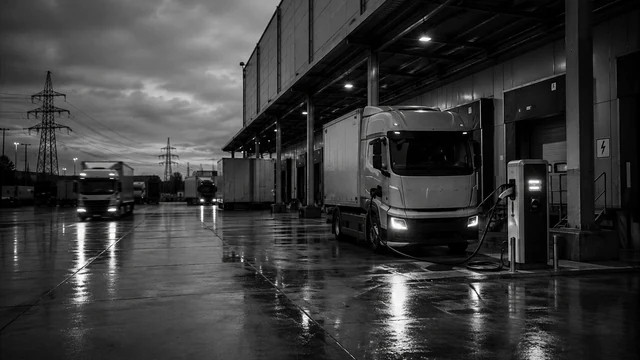
It sounds almost unbelievable, but it happens more and more often: a new distribution centre is completed, the racking is ready, the equipment has been ordered and the staff can start, but only the electricity connection is still months, or even years, away. The result is that some companies postpone going live, while others are forced to invest in diesel or gas generators just to get the operation started. That is not only a significant cost, but also a bitter reality for organisations that are investing heavily in sustainability.
Electrification doesn't stop at the solar panels
Many companies are taking major steps towards a more sustainable operation. Roofs are covered with solar panels, gas disappears from the building, and internal transport is increasingly electrified too: electric forklifts, reach trucks, pallet trucks and AGVs are now standard in many warehouses.
I often hear the same reasoning: "We have thousands of solar panels on the roof, so charging our trucks isn't a problem." That sounds logical, but reality tends to work a little differently.
Energy consumption isn't the problem, peak power is
An electric forklift of around two tonnes uses on average about 4 kWh per operating hour while driving. That may sound like a lot, but that's usually not where the challenge lies: during operation, the battery simply supplies the energy it needs. The real issue only arises once that battery needs to be recharged, and that tends to happen at exactly the wrong moment.
In many warehouses, trucks are plugged into the charger at the end of the shift, logical, since they need to be fully available again the next morning. Only that is also precisely the moment when the solar panels are producing barely any energy. During the day you generate plenty of sustainable energy, but in the evening virtually all of the charging energy still has to come from the electricity grid. For a small fleet, that is usually not a big problem, but when dozens or even hundreds of trucks are charged at the same time, the energy question suddenly looks very different.
That is because two different things are at play here, and they are easy to confuse:
Energy consumption = how much power you use in total over a full day
versus
Peak power = how much power is demanded at a single moment
With grid congestion, peak power is almost always the real bottleneck, not total consumption. A grid connection isn't sized for what you use on average per day, but for the highest power you can demand at any given moment.
How large that peak power can get
Where traditional chargers require relatively limited power, modern lithium-ion systems increasingly demand charging power of 30 kW or more per truck, and that is often still for relatively small machines such as forklifts or reach trucks. That is fantastic for equipment availability, but run the following example through your head.
The problem doesn't arise because too much energy is used over the whole day, but because an enormous amount of power is demanded at a single moment. And the development doesn't stop at forklifts: more and more companies are also electrifying their heavier equipment, such as container handlers, terminal tractors and reach stackers. Charging power of 250 to even 500 kW is no longer an exception for this kind of machine, which means a single charger can already demand as much power as an entire residential neighbourhood. That is exactly what makes energy management today at least as important as the choice of equipment itself.
Lithium-ion helps, but doesn't solve it on its own
Lithium-ion batteries offer many advantages over traditional lead-acid batteries. They can be charged in between, during breaks or throughout the working day, so a larger share of the charging process coincides with the moments when the solar panels are actually producing a lot of energy. Battery-swap systems can also help spread charging better across the day. That makes lithium-ion an interesting solution, but it doesn't make the peak-power challenge from the previous section disappear: if a hundred trucks still start charging around the same time, the demand spike remains, regardless of battery type.
More options than many companies think
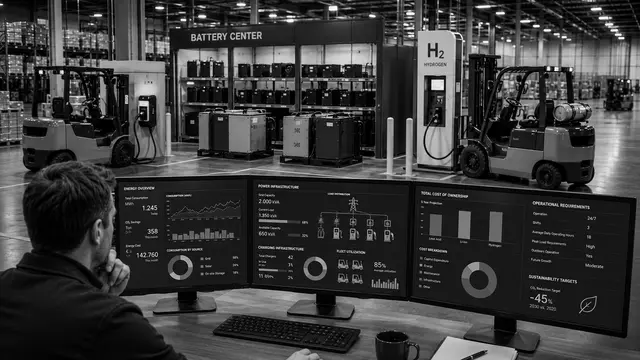
When companies run into the limits of their grid connection, the first reaction is often: "then we need a heavier connection." That solution is not always available, and frankly, it's not always the best one either. Fortunately, there are now many smarter ways to make optimal use of the available capacity:
- Smart charge management. Systems that automatically prevent all chargers from charging at maximum power simultaneously, and that communicate with each other to dynamically distribute the available power.
- Phased charging schedules. Vehicles are charged one after another instead of all at once, spread across the night or across several break periods.
- Charging during the day instead of the evening. Lithium-ion trucks topped up during breaks make direct use of the solar power generated at that moment.
- Battery-swap systems. Charging moments are decoupled from the end of the shift and spread more evenly across the day.
- Stationary buffer batteries. These store surplus solar power during the day and use it in the evening to charge internal transport equipment, or deliver temporary extra capacity during power peaks so the maximum load on the grid connection is not exceeded.
It often turns out that a combination of these solutions is already enough to make far greater electrification possible than initially expected.
Energy becomes a logistics design question
Where the choice of a forklift used to revolve mainly around capacity, ergonomics, reliability and cost, today a whole set of extra questions comes into play. These are no longer separate technical details, they are logistics design questions that are best answered early in a project:
Questions that now routinely come up with new equipment:
- Does this solution fit within the available energy infrastructure?
- Which battery technology is most suitable for this use?
- Exactly when is charging done, and how many trucks charge at the same time?
- What does the solar roof actually deliver, and at which moments?
- Is a stationary buffer battery cost-effective for this fleet?
- How do you prevent peak load on the grid connection?
- What will the situation look like in five or ten years as the fleet keeps growing?
Don't start with the truck, start with the bigger picture
Electrification is much more than replacing a diesel truck with an electric one. It's about the interplay between equipment, charging infrastructure, energy generation, grid capacity and the daily operation, and that is exactly where the biggest opportunities, and the biggest pitfalls, arise. Companies that think about this early avoid surprises during implementation and get much more return from their investments.
The energy transition doesn't just call for different machines, above all it calls for a different way of thinking. And it may well turn out that the solution isn't a heavier grid connection at all, but a more intelligently designed logistics operation.
Frequently asked questions
What is grid congestion and why does it affect logistics companies?
Grid congestion is the situation in which the electricity grid has insufficient capacity to facilitate all requested connections or power demand. Logistics companies feel this because a new or heavier grid connection is not simply available, even though the warehouse or fleet is already ready for use.
Why isn't charging with solar panels automatically enough for electric forklifts?
Trucks are often charged at the end of the shift, exactly the moment when solar panels produce barely any energy. During the day you generate sustainable energy, but in the evening most of the charging energy still has to come from the grid, especially with larger fleets.
What is the difference between energy consumption and peak power when charging forklifts?
Energy consumption is about the total amount of power used over a day. Peak power is about how much power is demanded at a single moment, for example when a hundred trucks start charging simultaneously. With grid congestion, peak power is often the real bottleneck, not total consumption.
What solutions exist for grid congestion in a warehouse?
Think of smart charge management systems that dynamically control chargers, phased charging schedules, lithium-ion trucks charged during daytime breaks, battery-swap systems, and stationary buffer batteries that store solar power during the day and deliver extra capacity during charging peaks.

Sjef Kerkvliet is the founder of OctaFlow and has more than 15 years of experience in intralogistics, warehouse optimisation and internal transport. Drawing on his hands-on experience, he helps organisations with questions around goods flows, process improvement, warehouse layout, automation and operational efficiency.
Want to talk about your operation?
A logistics or operational challenge? OctaFlow is happy to think along. No fuss, just a good conversation.