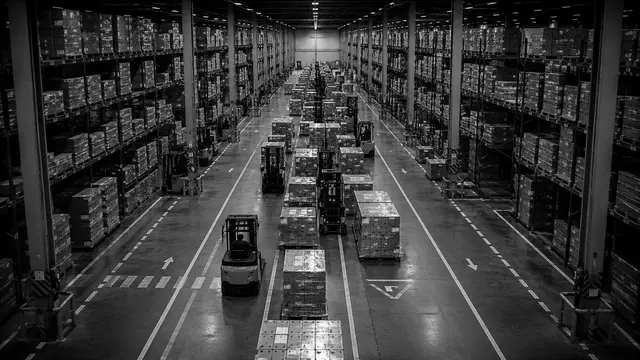


A strong improvement starts with insight. A logistics operation can look fine on paper while, in daily practice, time, capacity and money are lost. Waiting time, unnecessary driving or walking distances, inefficient working methods, or processes that no longer match the current situation after growth or change, are not always immediately visible.
The question is therefore not which solution to buy first or which process to change immediately. The first step is understanding what is actually happening.
With the Operational Quick Scan, OctaFlow examines the day-to-day operation independently and in a focused way. We look not only at processes as they are designed on paper, but above all at how goods, people and equipment actually move through the organisation in practice. Through observation, conversation and analysis, a clear picture emerges of the main bottlenecks, underlying causes and improvement priorities.
The result is an independent starting point for further decision-making. First understand what is really happening, then decide what needs to change.
When is an operational quick scan worthwhile?
An Operational Quick Scan is especially valuable when the day-to-day operation no longer matches the current situation as a matter of course. This can be the case, for example, when volumes have grown without processes or working methods being adjusted, when employees regularly have to wait, search or take detours, or when there is discussion about extra staff or equipment without it being clear where the underlying problem lies.
It can also be worthwhile when available warehouse space increasingly seems insufficient, when performance is lagging, when different departments each have their own explanation for a problem, or when management information gives insufficient insight into what is actually happening on the work floor.
A quick scan does not have to wait until an operation actually grinds to a halt. Early insight can deliver a great deal of value precisely when there is still room to make choices, before problems lead to major investments, higher staffing costs or capacity issues.
What does OctaFlow examine?
An Operational Quick Scan has no standard checklist that is applied the same way at every organisation. The exact focus is determined by the operation, the reason for the assessment and the questions that matter within the organisation. Depending on the question, we look at some or all of the following.
Process flows
How do goods move through the operation, and where do handovers, waiting time or unnecessary movements arise? We map the main goods flows and examine where processes reinforce or slow each other down.
Routing and distances
We assess how goods, employees and equipment move through the organisation. This includes driving and walking distances, routes, crossing points and recurring movements that may not be necessary.
Deployment of people
Where does the available working time actually go? We look at productive work, waiting time, searching, movement and other activities that can limit employees' effective capacity.
Deployment of equipment
We analyse how the available material handling equipment is used, including availability, usage profiles, waiting time, peak load and possible under-utilisation of the existing fleet.
Capacity and utilisation
Where does the real capacity constraint in the operation actually sit? We distinguish between a genuine lack of capacity and situations where existing capacity is simply not being used well.
Working methods
We examine how work is actually carried out and why a particular method was chosen. A method that once made sense can become less effective as volumes, processes or circumstances change.
Cooperation between departments
An operational problem rarely originates entirely within one department. A disruption at shipping, for example, may actually originate in inbound, inventory management, planning or order picking. That is why we assess the coherence between the different parts of the operation.
Information and decision-making
We look at what information is used to make operational decisions and how closely that information matches the reality on the work floor. Reliable decision-making starts with reliable inputs.
How does an Operational Quick Scan work?
-
Sharpening the question upfront
A good analysis starts before OctaFlow arrives on site. We discuss the reason for the quick scan, developments within the organisation, and the questions the analysis needs to answer.
Where possible, relevant information is gathered in advance, for example on volumes, processes, locations, equipment and operational performance. This information is used to place on-site observations in the right context, not to determine the outcome of the assessment beforehand.
-
Observing the operation on the work floor
Next, we examine how the operation actually functions. We look not only at the formal process description, but observe the day-to-day work and the way employees, goods and equipment move through the organisation.
We pay attention to waiting time, congestion, searching, unnecessary movement, exceptions, and differences between the designed way of working and daily practice. Those differences often deliver the most important insights.
-
Conversations with employees and management
Figures and observations tell an important part of the story, but the people who work with the operation every day hold knowledge that does not always show up in data.
Depending on the assignment, we talk to employees, team leaders, planners and management. The goal is not to assign blame, but to understand why processes play out the way they do in practice.
A structural detour, for example, may have arisen because a particular route turns out not to be usable in practice. Without the perspective of the work floor, a cause like that can easily be missed.
-
Identifying patterns and underlying causes
A visible deviation is not automatically the real problem. If a forklift regularly stands waiting, that does not automatically mean an extra forklift is needed. Long walking distances do not automatically mean extra staff are required either.
That is why we investigate which causes lie behind the visible problems, how structural they are, which other processes they affect, and what happens if nothing changes.
This is what creates the difference between an overview of symptoms and an analysis that decisions can actually be based on.
-
Determining findings and priorities
Not every improvement point has the same impact or urgency. That is why we distinguish between immediate bottlenecks, structural causes, possible quick wins, higher-impact improvement points and topics that need further investigation.
The goal is not to deliver a long list of loose recommendations, but to give insight into the topics that genuinely matter most to the organisation.
What does the quick scan deliver?
The main output of the Operational Quick Scan is an independent, well-founded picture of the current operation. The analysis provides insight into:
- where the operation is demonstrably struggling;
- which inefficiencies are visible;
- which causes are likely behind them;
- where capacity is being lost;
- which improvement points deserve priority;
- which topics justify further investigation.
The findings are recorded in a clear report. The goal is not to produce as many pages as possible, but to capture the relevant insights in a usable, well-organised way.
The quick scan often forms the starting point for a next decision. Depending on the outcome, that could be a further operational analysis, a business case, an investment decision, or a concrete improvement project.
What does OctaFlow deliberately not do?
An independent quick scan does not start with a predetermined solution. OctaFlow does not arrive with the assumption that a certain number of new forklifts, an automation solution or a new warehouse layout is needed. The first question is always whether and where a change is actually needed.
The Operational Quick Scan is therefore primarily aimed at establishing the current situation, the main bottlenecks and the underlying causes. The assessment forms an independent basis for follow-up decisions.
If there is a need afterwards for solution directions, a business case or implementation support, a separate follow-up track can be set up for that. The starting point remains the same: first establish the operational need, then look at the solution.
When is a quick scan not the right step?
An Operational Quick Scan is not the best approach in every situation. When an organisation already knows exactly what the problem is, has reliable operational data, and only needs support executing an already-chosen solution, a different track can make more sense.
For very specific questions too, for example when only safety, equipment deployment, energy transition or a tender needs to be examined, a targeted analysis can be more efficient.
That is why we always look first at the reason and the concrete question. Good advice does not start with the service a consultant wants to sell, but with the question the organisation is actually trying to answer.
What does an Operational Quick Scan cost?
The scope of an Operational Quick Scan varies by organisation and question. Plan for 1 to 3 days on site: the number of employees, the size of the warehouse in square metres, the number of locations and the complexity of the logistics together determine how much assessment is needed.
That is why OctaFlow does not work with a single fixed rate for every quick scan. After an intro call, we determine which approach fits and what investment goes with it. That way you pay for an analysis that matches the actual scope of the question, rather than for a standard package that may be too large or too limited.
From a first indication to independent insight
Not sure yet whether a full quick scan is needed? OctaFlow developed the free Online Performance Check for exactly this. With 15 questions about the logistics operation, it gives a first indication of possible attention points. The online check is explicitly not a substitute for an on-site assessment, but it can help determine which topics deserve further attention.
The Operational Quick Scan then goes a step further. Here, the day-to-day operation is actually examined on site through observation, conversation and analysis. The Online Performance Check gives a first direction, the Operational Quick Scan gives insight into what is actually happening in practice.
Start the free Online Performance Check →
Frequently asked questions
What is an operational quick scan?
An operational quick scan is a focused analysis of the day-to-day operation. OctaFlow observes processes on site, talks to the people involved, and maps out bottlenecks, inefficiencies and likely causes. The goal is to build independent insight into the current situation before decisions are made about improvements or investments.
What is the difference between the free Online Performance Check and the Operational Quick Scan?
The Online Performance Check gives a first indication of possible attention points based on 15 questions about the logistics operation. The Operational Quick Scan goes considerably further: the operation is actually examined on site through observation, conversation and analysis. The online check gives direction, the quick scan captures the day-to-day practice and the key improvement points.
How long does an Operational Quick Scan take?
Plan for 1 to 3 days on site. The exact duration depends on the number of employees, the size of the warehouse in square metres, the number of locations and the complexity of the logistics. These factors determine the scope of the assessment upfront.
Do I get a solution straight after the quick scan?
Not necessarily. The quick scan is meant to first establish what is really going on, where the main causes lie and which improvement points deserve priority. If there is a need afterwards for a solution direction, a business case or implementation support, that can be set up as a separate follow-up track.
Is a quick scan only suitable for warehouses?
No. The approach can be applied in warehouses, distribution centres, production environments and other organisations where intralogistics and operational processes play an important role. The content of the analysis is tailored to the specific situation and question.
Is OctaFlow independent?
Yes. OctaFlow does not sell forklifts, warehouse automation or other specific supplier solutions. That means the analysis can start from the organisation's operational need, without a particular product solution as the starting point.
A better operation starts with insight
An operational improvement does not always start with an investment. The right choice starts with insight into the current situation. OctaFlow maps the day-to-day operation independently, practically and with solid evidence.