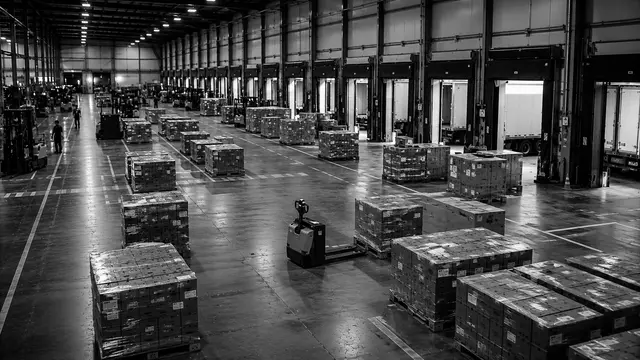

Safety within a warehouse or logistics environment is often approached through rules, instructions and behaviour. Those elements matter, but a safe operation isn't determined only by the people working in it.
The layout of the working environment, traffic flows, routing, sightlines, equipment and working methods have at least as much influence on how employees move through an operation every day.
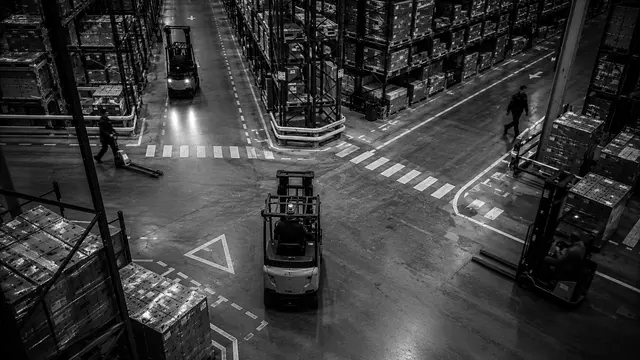
A situation can formally comply with the rules in place and still create unnecessary risk in practice: a crossing with limited visibility, pedestrians using the same route as internal transport, a loading and unloading area where different traffic flows converge, or an aisle where manoeuvring is structurally difficult.
OctaFlow examines safety from the perspective of the total operation, looking at the physical layout and at the way people, goods and equipment actually move through the organisation.
The goal is not only to record existing risks, but to understand why certain risks arise and which measures can structurally improve safety.
When is a Safety Scan worthwhile?
A Safety Scan is worthwhile when there is doubt about the safety of daily operations, or when incidents, near-misses or changing conditions give reason to reassess the working environment. That can be the case, for example, when:
- forklifts and pedestrians use the same routes;
- near-collisions occur regularly;
- certain crossings or passages are experienced as confusing;
- damage or incidents keep happening at fixed locations;
- traffic flows have changed over the years;
- a warehouse or production site has been redesigned;
- new machines or automation have been added;
- the operation has grown significantly;
- walking and driving routes aren't sufficiently separated;
- sightlines are limited by racking, goods or other obstacles;
- employees regularly have to deviate from the intended route;
- existing safety measures no longer match the current situation.
A safety scan can also be valuable even when no serious incidents have occurred yet. A safe operation doesn't only become important after something goes wrong; recognising situations where an incident could easily arise creates the opportunity to remove risks in advance.
What does OctaFlow look at?
Safety is the result of several factors that influence each other. That's why we don't look exclusively at individual employees or isolated safety provisions. Depending on the question, we assess some or all of the following.
Driving routes and traffic flows
How do forklifts, reach trucks, pallet trucks, AGVs and other vehicles move through the organisation? We look at driving directions, crossings and manoeuvring space.
Pedestrian routes
Where do employees and visitors walk? Are walking routes logical, recognisable and sufficiently separated from internal transport?
Crossings and sightlines
We assess sightlines, obstacles, corners, doors, racking and other conditions that can limit timely awareness of traffic.
Collision protection
We assess where collision protection is relevant, whether it's logically placed, and whether existing provisions match the risks actually present in practice.
Traffic layout and marking
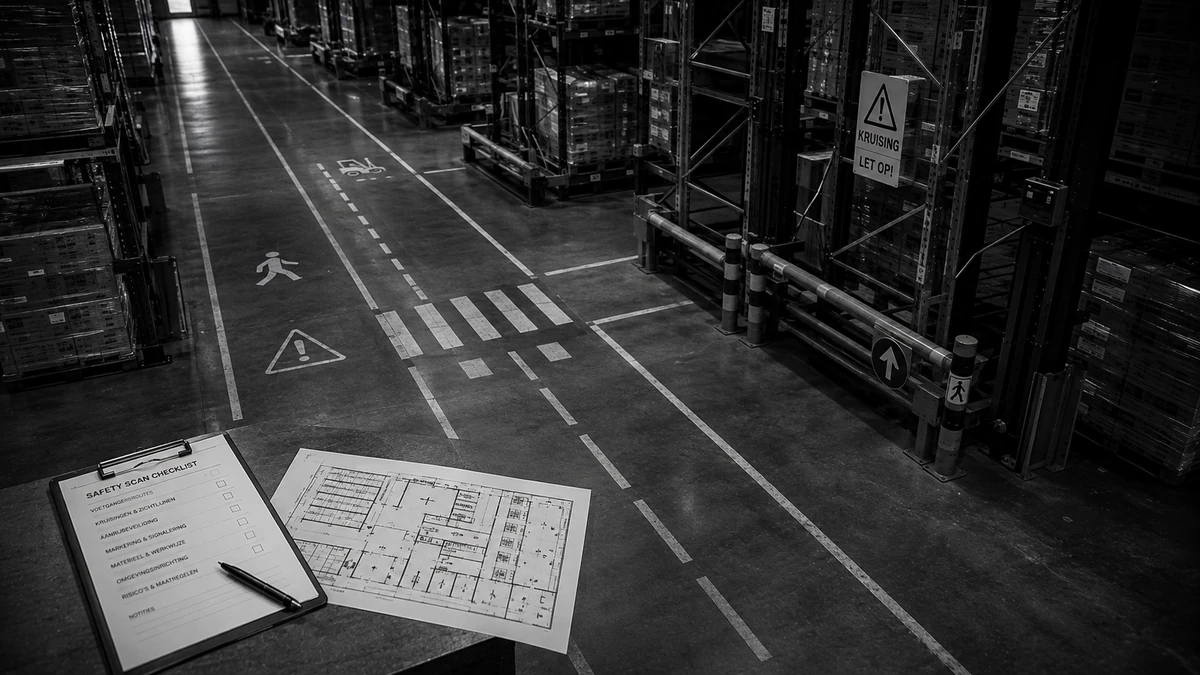
Floor markings, traffic signs, stop lines and driving directions support desired traffic behaviour. We check whether they are logical, visible and understandable.
Equipment and safety systems
Visibility, dimensions, speed, safety systems, lighting, and how suitable the equipment is for the environment it operates in all play a role.
Working methods and behaviour
Behaviour is often a response to the conditions someone has to work in. A safety rule that is barely workable may call for adjusting the operation rather than just extra instruction.
Environment layout
We assess aisle widths, storage locations, loading and unloading zones, docks, doors, racking and obstacles.
How does a Safety Scan work?
-
Establishing the safety question
We start with the reason for the analysis. Have there been incidents? Are there recurring near-misses? Has the site changed? Or does the organisation want preventive insight into possible risks? When incident data, floor plans or other relevant information is available, it's factored into the preparation upfront.
-
Assessing the working environment on site
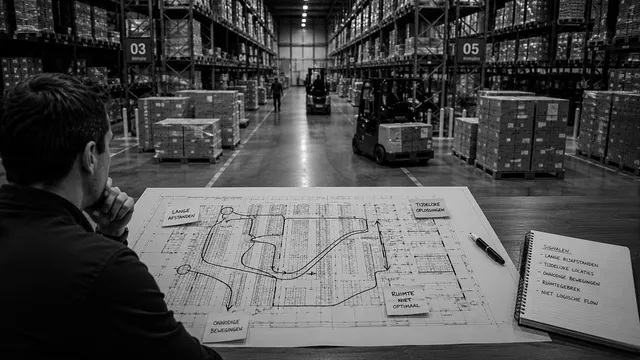
Next, we look at daily practice on site, observing how employees, internal transport and other traffic flows actually move through the organisation. We look not only at the intended routes, but at the routes that emerge in practice, which is often exactly where important safety risks become visible.
-
Identifying risk situations
Based on observations and available information, we map situations where the likelihood of an incident, or its potential impact, is greater. We look at, for example:
- crossing traffic flows;
- limited sightlines;
- insufficient manoeuvring space;
- unclear routing;
- insufficient physical separation;
- unsuitable or missing protection;
- deviating work behaviour;
- situations where multiple risks combine.
-
Determining causes and coherence
An unsafe situation often has several causes. A crossing might be confusing because of where a rack is positioned, while traffic intensity at that location further increases the risk. When employees then work under time pressure, the likelihood of an incident can increase further still. That's why we look not only at the visible risk, but at the conditions contributing to it.
-
Determining improvement measures
Measures are then determined that match the risks found. This can relate to routing, traffic separation, physical protection, marking, sightlines, layout, speed, equipment, working methods, technical safety systems, behaviour and instructions. Where possible, we prefer measures that reduce risk at the source rather than relying solely on employee alertness.
-
Determining priorities
Not every risk requires the same investment or has the same urgency. We distinguish between immediate improvement points, relatively simple quick wins, and measures that require bigger organisational or technical change.
Safety doesn't start with a warning sign
A common reaction to an unsafe situation is adding a sign, a line, or an instruction. Sometimes that's exactly the right measure. But when the underlying layout keeps causing the risk, an extra sign changes little.
When a pedestrian route structurally crosses internal transport, for example, it's more relevant to examine whether both traffic flows can be organised differently than to simply add another warning sign. The same applies to tight manoeuvring space or a confusing crossing.
The best safety measure is often the one that stops employees having to constantly rely on their own alertness.
Safety and damage reduction are closely linked
Safety and damage are sometimes treated as separate topics within organisations. In daily operations, they regularly share the same causes.
An illogical traffic route can lead to both an unsafe situation and damage to a rack. Limited sightlines can pose a risk to employees while also causing collisions with equipment.
That's why insights from a Safety Scan can also lead to measures that reduce damage and operational cost. When damage and cost are the primary question, Damage reduction & cost control may fit better. When the safety of the total working environment is central, OctaFlow focuses the analysis specifically there.
What does a Safety Scan deliver?
A good Safety Scan gives insight into how safety actually functions as part of daily operations. Depending on the question, the analysis can give insight into:
- present safety risks;
- risky traffic situations;
- bottlenecks in driving and walking routes;
- sightline problems;
- missing or insufficient physical protection;
- ambiguities in traffic layout;
- situations where behaviour and working environment influence each other;
- concrete quick wins;
- structural improvement measures;
- priorities for further improvement.
The goal is not to produce as long a list of risks as possible. The goal is to give insight into which risks are relevant, why they arise, and which measures have the most effect.
What does OctaFlow deliberately not do?
A Safety Scan is not a hunt for individual employees' mistakes. When someone doesn't follow a safety rule, it's important to understand why: sometimes it's a matter of insufficient instruction or deliberate risk-taking; in other cases, the prescribed way of working is awkward, inefficient or hard to carry out in practice.
A Safety Scan is also not used as a replacement for legal obligations, formal risk assessments or specialist safety inspections where these are required. OctaFlow focuses on the operational safety question within the logistics environment and makes clear where daily layout, processes and traffic flows can be improved. Where specialist or legal expertise is required, that expertise needs to be brought in.
Improving safety starts with knowing where the risk actually originates.
When is a Safety Scan not the right step?
When the safety question relates purely to a specific technical component, legal certification or a formal safety assessment, specialist expertise may be required.
Also, when the main problems don't lie in safety but relate, for example, to general operational inefficiency, an Operational Quick Scan or optimisation project may fit better.
When damage and collisions are the trigger, a damage reduction project can give more insight into the underlying causes.
The right approach therefore depends on the question the organisation actually wants answered.
What does a Safety Scan cost?
The scope of a Safety Scan differs by site and question. An analysis of one warehouse with a limited number of traffic flows requires a different approach than a large site with multiple halls, shift patterns, intensive internal transport and various traffic flows. The desired depth and any support implementing measures also determine the scope.
That is why OctaFlow does not work with a single standard price. After an intro call, we determine which analysis fits and what investment it requires.
Frequently asked questions
What is a Safety Scan?
A Safety Scan is a focused analysis of safety risks within a logistics or operational environment, looking at traffic flows, driving and walking routes, sightlines, layout, equipment, safety systems and behaviour. The goal is to surface risks and improvement opportunities and translate them into concrete measures.
What does a Safety Scan look at?
Depending on the site, it looks at driving routes, pedestrian routes, crossings, sightlines, collision protection, traffic marking, equipment, safety systems, working methods and the physical layout of the environment.
Is a Safety Scan the same as a formal risk assessment?
No. OctaFlow's Safety Scan focuses specifically on practical safety within the logistics and intralogistics operation. A formal risk assessment (RI&E) is a legal instrument with a broader statutory context. A Safety Scan does not replace legal obligations or formal safety assessments where these are required.
How do you prevent forklift collisions?
Collisions can have various causes: unclear crossings, limited space, confusing traffic flows, insufficient separation between pedestrians and internal transport, or conditions where employees work under high pressure. The best approach is to first establish where and why collisions or near-misses occur, then tackle the underlying causes.
Is extra training enough to improve safety?
Training is important but not always sufficient. When multiple employees cause similar risks, it's worth also looking at layout, routing, working methods and available resources. Structural safety problems usually require a combination of organisational, technical and behavioural measures.
Can OctaFlow help with traffic safety in a warehouse?
Yes. Traffic safety within a warehouse is a key part of a Safety Scan, looking at the interaction between pedestrians, internal transport and other traffic flows, and the layout that supports these movements.
A safe operation is a well-designed operation
OctaFlow doesn't only examine whether safety rules are being followed, but above all how the daily operation is laid out and which conditions influence safety. That builds a practical, independent picture of the main risks.