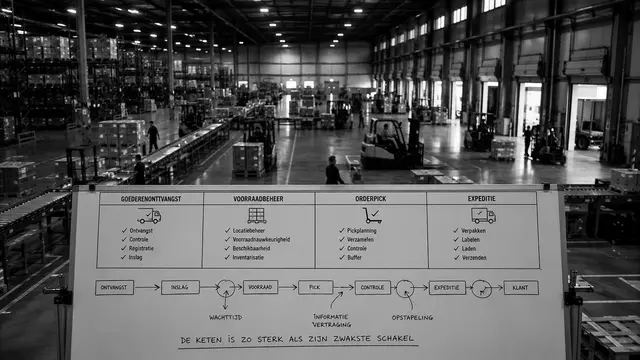
Logistics process optimisation is regularly on the agenda at many organisations. Increasing volumes, rising costs and higher expectations from customers mean that processes are continuously under pressure. At the same time, I notice that the discussion often moves towards solutions quickly. New systems, automation or expanding capacity are regularly mentioned first, while the question of where the actual problem lies is sometimes only asked later.
Logistics process optimisation means structurally improving existing ways of working within a logistics operation, often starting with the question of why a process is organised the way it is, rather than jumping straight to new systems or capacity.
That is exactly where logistics process optimisation often begins in practice.
Processes often grow gradually
What makes logistics processes interesting is that they are rarely designed all at once. Many ways of working develop gradually as organisations grow. A new customer makes specific demands, a temporary solution stays around longer than planned or a department organises processes differently to solve an operational problem.
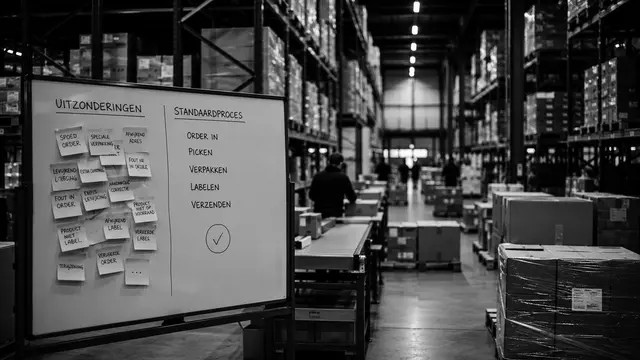
In themselves these are often logical decisions. Together, however, they can make processes increasingly complex without this being noticed directly. As a result, ways of working arise that function for years, while nobody asks any more why certain steps are actually carried out.
That does not mean the process does not work. Often the operation even functions surprisingly well. At the same time, small inefficiencies can pile up unnoticed, causing capacity to be lost without this being directly visible.
The shop floor often tells a different story
What strikes me here is that processes often appear to function better on paper than in practice. Reports show, for example, that performance stays within target, while employees run into the same obstacles every day.
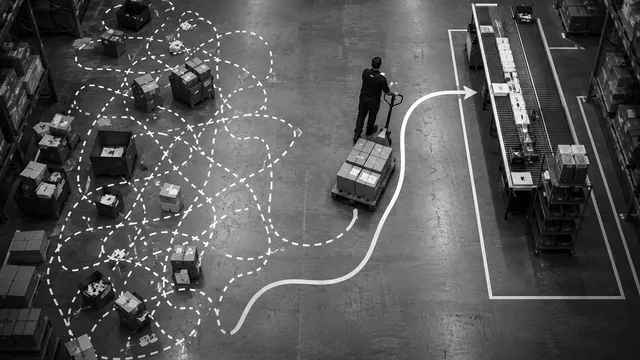
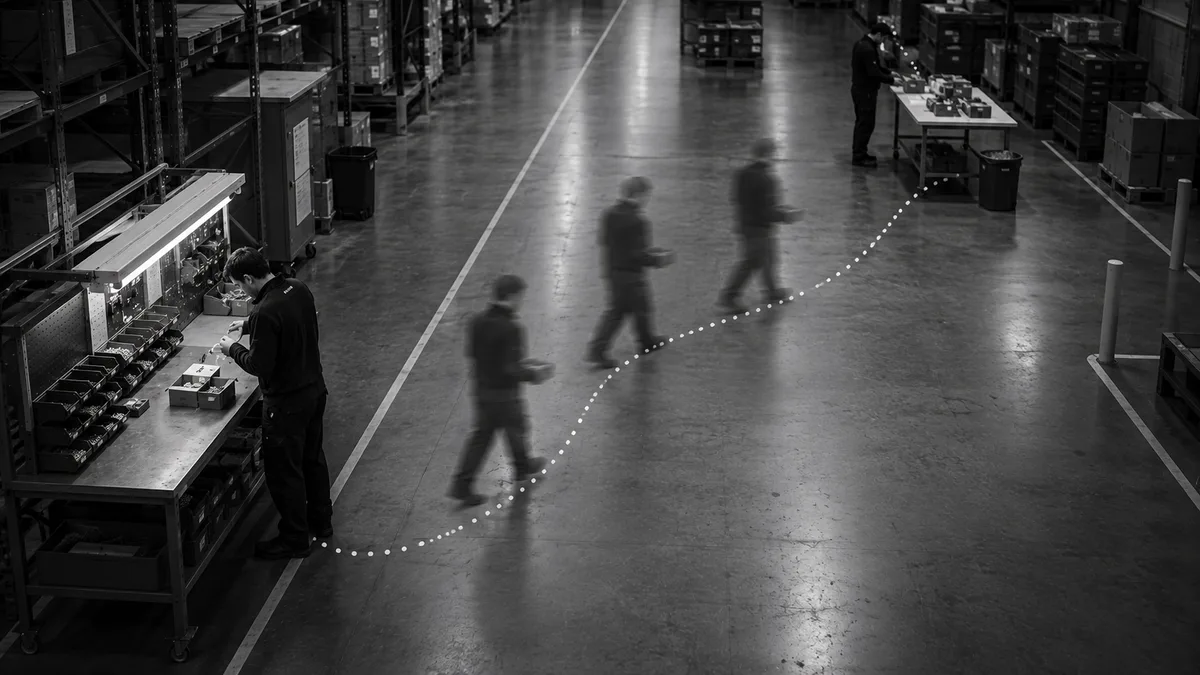
An example that has always stayed with me took place at an organisation where displays were assembled. During the work, an employee had to fetch parts dozens of times a day from a table about thirty metres away. For everyone, that had become completely normal. It was simply part of the process.
The interesting question, however, was not how much time this cost, but why that table was actually there. When that question was asked, it turned out nobody had a clear answer. The table was there because it had always been there.
On its own, such a situation may seem unimportant. Yet employees unknowingly walk enormous distances on an annual basis when this kind of choice becomes part of the daily way of working. By looking at the process again and asking the simple question ‘why?’, a different setup of the work process eventually emerged.
I come across exactly those kinds of situations regularly. Not because people want to work inefficiently, but because processes develop over the years and certain choices are never reconsidered.
Not every inefficiency calls for an investment
When organisations think about process improvement, attention often goes to new resources or technology. That is understandable. Innovations can make an important contribution to the performance of an operation.
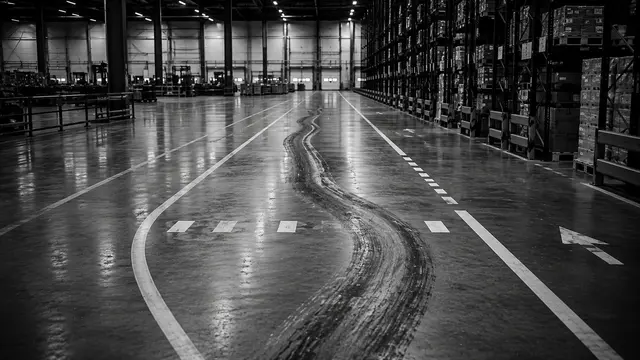
At the same time, I regularly see situations where the cause of a problem does not lie in a lack of resources, but in the way existing processes are organised. An extra forklift solves little, for example, when drivers cover unnecessarily many metres every day. In the same way, extra warehouse space will not always have the desired effect when goods are moved several times before reaching their final destination.
That does not mean investing is never the right choice. But I do see that the best solution often only becomes visible once the underlying process is properly understood.
Understand before you improve
What many successful improvement projects have in common is that the cause is examined first before looking for solutions. How do goods move through the operation? Where do waiting times arise? Which process steps actually add value and which have become part of the standard way of working over the years?
It is precisely these questions that make visible where improvements are possible. Not because employees do not do their work well, but because processes often develop differently than originally intended.
The biggest gains therefore regularly arise not from working harder, but from organising more intelligently.
Asking the right question
Logistics process optimisation is ultimately not only about efficiency. It is about creating an operation that aligns better with daily practice, copes better with growth and becomes less dependent on temporary solutions.
The discussion is therefore not only about systems, automation or capacity. Ultimately it is about the question of how people, processes and resources can work together so that an organisation achieves its goals without adding unnecessary complexity.
And that is exactly why logistics process optimisation often starts somewhere other than many people think.
Frequently asked questions
What is logistics process optimisation?
Logistics process optimisation is analysing and improving logistics processes in order to work more efficiently, safely and effectively. It looks at the coherence between people, resources, goods flows and ways of working.
Where do you start with logistics process optimisation?
In many cases process optimisation starts with understanding the current situation. By observing processes in practice and making bottlenecks visible, insight arises into where the biggest improvement opportunities lie.
Does process optimisation always mean investing?
No. Although investments can be part of the solution, many improvements come from organising existing processes more intelligently, removing unnecessary steps or deploying resources more efficiently.

Sjef Kerkvliet is the founder of OctaFlow and has more than 15 years of experience in intralogistics, warehouse optimisation and internal transport. Drawing on his hands-on experience, he helps organisations with questions around goods flows, process improvement, warehouse layout, automation and operational efficiency.
Want to talk about your operation?
A logistics or operational challenge? OctaFlow is happy to think along. No fuss, just a good conversation.