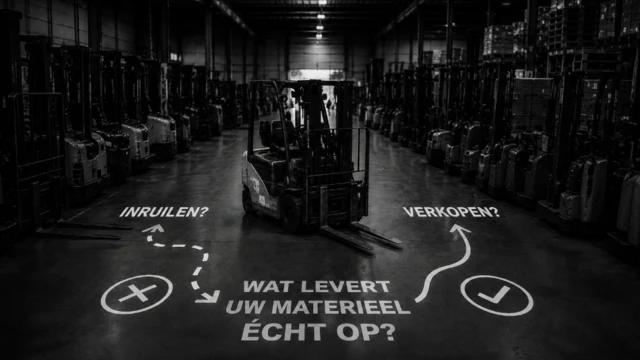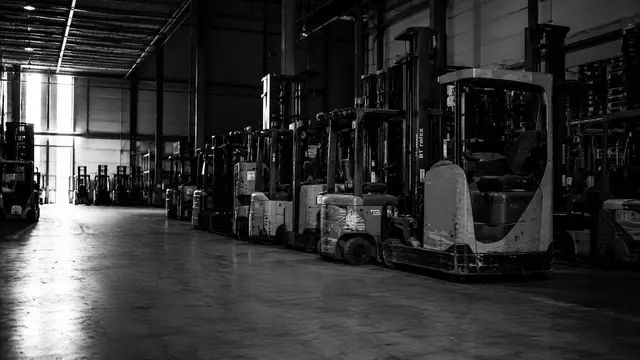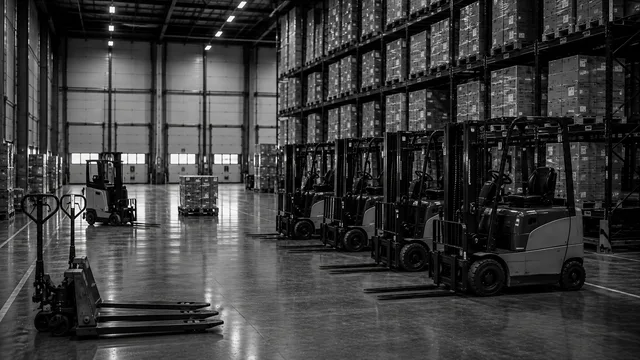

"What is my forklift worth?" is the question I get most often as soon as equipment becomes surplus. There is no price list you can look it up in. There is a list of things a buyer looks at, and it is longer than most owners expect.
The residual value of a used forklift is the amount a buyer is willing to pay right now. It is set by the specification, the technical condition, the running hours, the industry the machine worked in and current demand in the second-hand market. The same machine can be valued far apart by two different buyers without either of them being unreasonable.
Almost everyone starts with year and hours. Understandably, because those are the two numbers on the data plate and the meter. But I have seen machines of the same year with comparable hours standing side by side with more than double the difference between them.
That difference sits in everything else. Below is what a buyer actually looks at.

- 1Mast and lift height
how high it goes, and how many buyers need that - 2Free lift
whether it can work inside a container - 3Forks and attachment
sometimes worth more than the machine under it - 4Tyres
type and remaining tread - 5Cab and overhead guard
indoor work or outdoor work - 6Controls
levers or fingertip, three wheels or four - 7Drive and battery
the biggest unknown on an electric truck - 8Dimensions and turning circle
which aisle it still fits
Year, running hours and make
Hours weigh more heavily than age. A 2015 machine with 4,000 hours is usually worth more than a 2020 one with 18,000. Hours say something about wear; age mostly says something about technology and appearance.
But very few hours on an old machine is a signal too. A forklift that stood still for most of ten years often has dried-out seals, a battery that was never properly cycled and rust in places you do not look. Standing still is not free preservation.
The make mainly determines sellability. Some brands hold their value better, not because they are inherently better, but because there are more buyers for them and parts are available everywhere. For export that counts double: a make without a dealer network in the destination country is simply worth less there.
The specification, and why higher is not always more
Lift height. A standard 3,300 mm mast sells to everyone. A seven-metre mast sells to a handful of parties who happen to need that height. Higher is therefore not automatically worth more; it is often less liquid. The same applies in reverse to an extra low mast built for a specific door height.
Free lift. This is a yes-or-no that makes a surprising difference. Without free lift the mast rises immediately, so you cannot work inside a container or a trailer. That removes a large part of the market. With full free lift, exactly the same machine is interesting to many more buyers.
Overall height. How tall the machine is with the mast lowered determines where it can go inside, and whether it fits in a sea container. If it does not fit, export falls away as a channel, and export is a large part of the second-hand market. This is the number almost no owner thinks of and every dealer asks about straight away.
Length, width and turning circle. These three decide which warehouse it still fits. A narrow machine that turns tightly is widely usable. A wide machine with a large turning circle only fits generous aisles, and that narrows the group of buyers.
Attachment. Sometimes there is more value here than in the machine underneath. A paper roll clamp, a rotator, a fork positioner: those are expensive parts that can also be sold separately. At the same time, a very specific attachment makes the machine less liquid, because fewer buyers can use it. If there is nothing special on it, say whether it has a sideshift, because that is now expected as standard.
Cab. A closed, heated cab makes a machine suitable for outdoor work and for colder export markets. That raises the value. It also tells a buyer something else: a machine with a cab has probably stood outside, and that feeds into the question of rust.
Controls. Fingertip controls or a joystick are newer and nicer to use than separate levers, and you notice that in the price. Three or four wheels matters too: a three-wheeler turns tighter, a four-wheeler stands more stably on uneven ground. Neither is better; they serve a different buyer.
Drive and battery
Diesel, LPG or electric. In the Netherlands demand for diesel is falling because of emission zones and the policies of large shippers. In the export market it is very different: there a diesel machine is often exactly what is wanted, because charging infrastructure is missing. What falls out of favour here is sought after elsewhere.
On an electric machine the battery is the biggest unknown and often the biggest item. Replacing a worn traction battery quickly runs into thousands of euros, sometimes more than the machine itself still brings in. The battery year, the capacity in Ah and the number of charge cycles then determine the whole bid. Without that information a buyer prices in the worst case, and the owner pays for it.
Lithium changes the picture. A lithium pack is worth considerably more than lead-acid, but is often brand-bound and cannot simply be moved to another machine. That makes the machine as a whole more attractive and the pack on its own less tradeable.
If a second battery or a separate charger comes with it, say so. Those are independent, valuable items that otherwise end up with the buyer without anything being paid for them.
Condition, and what a buyer sees in the photo
Faults. A fault you report costs you less than a fault a buyer finds. A reported leak is priced in. A discovered leak is punished, because the buyer immediately wonders what else was not mentioned.
Tyres. Solid resilient, pneumatic or cushion, and how far they are worn. A set of tyres is a clear-cut item, but one that comes straight off the bid.
Clean or dirty. This is where the effect is underestimated most. A dirty machine is not only valued lower because it looks bad. A buyer reads something else into it: if the outside is in that state, how was the maintenance handled? An afternoon of cleaning and hosing down the mast is almost always the best-paid afternoon of the whole transaction.
Maintenance history. Not whether maintenance was done, but whether you can show it. A service folder or a contract with a known service partner takes uncertainty out of the bid. The last inspection belongs with that.
Where has it worked?
This is the factor almost nobody is asked about and that an experienced buyer smells first. Two identical machines with the same hours can end up far apart because of it.
A machine from a clean distribution centre handling wrapped pallets has had an easy life. A machine from recycling or waste processing has been eating dust and sharp material for years, and that sits in the bearings, the cylinders and the radiator. Concrete and brick load it abrasively. A cold store means constant condensation and temperature swings, which cause corrosion in places you cannot see. In food production machines are hosed down with water and cleaning agents, which does its own damage over time. On the coast or in a seaport, salt air plays a part.
So say where the machine has stood. That feels counterintuitive when the environment was harsh, but a buyer who finds out for himself deducts more than a buyer who knows in advance.
Supply and demand: the factor outside your machine
The machine can stay exactly the same while the price moves. When a large company renews its fleet, twenty comparable machines hit the market at once, and the price drops for everyone selling at that moment. The other way round, a shortage in an export market can push up the price for one particular type.
There is little an owner can do about timing, but there is one thing: do not sell at the moment that happens to suit you without asking what the market is doing.
Why this is hard to judge yourself
All of this together means there is no table in which you look up your machine. What does exist are buyers, and they differ strongly from one another.
One dealer specialises in export and mainly looks at simplicity and parts availability. Another supplies Dutch rental companies and wants a young electric machine with few hours. A third happens to have a customer looking for exactly this type right now, and pays more than the rest.
That is where the largest difference in proceeds sits: not in negotiating, but in which buyer the machine ends up with. And that is exactly what you cannot see when you get one offer from the party supplying your new machines. That is not a price, it is a proposal. More on that in the article on selling or trading in.
Frequently asked questions
What is my forklift worth?
There is no fixed price. Value is set by year and running hours, the specification (lift height, free lift, overall height, attachment, cab, controls), the drive and on an electric machine above all the battery, the technical condition, the industry the machine worked in and current market demand. Only once those points are known can a buyer name a realistic figure. The Residual Value Check collects a price from several buyers for you, free and without obligation.
Do running hours matter more than the year of manufacture?
Usually yes. An older machine with few hours is often worth more than a younger machine with many hours. That said, very few hours on an old machine carries its own risk, because long periods of standing still can damage seals and battery.
Does an attachment increase the value of a forklift?
Often it does, and sometimes considerably: a clamp or rotator represents substantial value in itself. At the same time a very specific attachment makes the machine less liquid, because the group of buyers who can use it gets smaller.
Is it worth cleaning a forklift before selling it?
Yes. A clean machine not only makes a better impression, it also removes doubt about maintenance. Buyers who cannot judge condition properly cover themselves, and that costs the owner money.
Does this apply only to forklifts?
No. The same factors apply to reach trucks, stackers, electric pallet trucks, order pickers, aerial work platforms, terminal tractors and scrubber-sweepers. Only the emphasis differs per type. All of them can be registered through the Residual Value Check.

Sjef Kerkvliet is the founder of OctaFlow and has more than 15 years of experience in intralogistics, warehouse optimisation and internal transport. From that hands-on background he helps organisations with questions around goods flow, process improvement, warehouse layout, automation and operational efficiency.
Want to talk about your operation?
A logistics or operational question? OctaFlow is happy to think along. No fuss, just a good conversation.