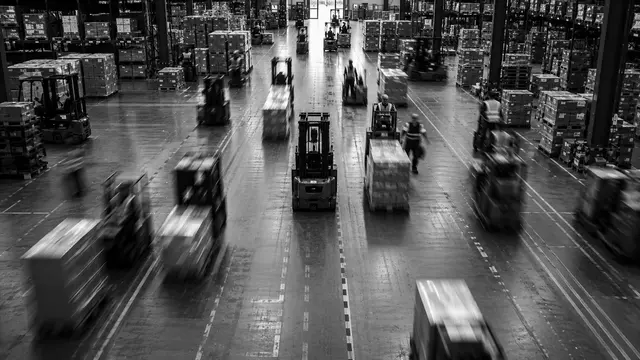

In retail and food, logistics above all needs to be reliable and predictable. Orders need to go out on time, stores and distribution points need to be supplied on schedule, and peaks shouldn't derail the operation.
At the same time, volumes aren't the same all year round. Promotions, holidays, seasons and shifting customer demand can cause big swings in workload within a short time.
OctaFlow helps retail and food companies set up their internal logistics so it stays efficient and manageable even during peaks.
Peak load is not the exception
A warehouse that runs fine on an average day can come under serious pressure during a promotion week or seasonal peak.
More orders don't just mean more work. The number of transport movements, replenishment, order picking movements and loading and unloading activity all increase too.
When the operation isn't set up for that, waiting times, congestion and extra staffing or equipment needs appear quickly.
That's why OctaFlow looks not just at the average situation, but specifically at the moments when the operation is under the heaviest load.
How many movements need to happen then? Where do bottlenecks arise? What capacity is actually needed? And how much of that capacity sits unused outside the peak?
Speed without chaos
In retail and food, speed matters, but working faster isn't automatically more efficient.
When order pickers get in each other's way, internal transport covers long distances, or goods are moved multiple times, pressure on the operation increases without adding extra value.
A good logistics setup therefore strikes a logical balance between:
- storage capacity
- order picking capacity
- replenishment
- internal transport movements
- staffing
- available floor space
- peak load
- lead time
The goal is an operation in which goods move through the process as efficiently as possible, without speed coming at the cost of oversight, safety or reliability.
Food demands extra reliability
Within food, there's an added dimension. Products can have shelf-life dates, specific storage conditions or different handling requirements. A mistake in the logistics operation can therefore go beyond just extra transport or a longer lead time.
Internal logistics needs to be not only efficient, but also predictable and controllable.
That requires a setup in which storage, order processing and internal transport flows connect logically.
Where OctaFlow helps
Within retail and food, several questions regularly come together. The most important are:
Warehouse optimisation
At high volumes, every unnecessary metre has an impact. OctaFlow analyses the logistics flows and looks for a layout that processes more volume without automatically adding space, people or equipment.
Read more about warehouse optimisation →Equipment advice
Retail and food operations often need equipment used intensively over long periods, with requirements that can differ sharply during peaks compared to an average working day. OctaFlow determines what equipment actually fits the operation.
Read more about equipment advice →Automation
For large, predictable goods flows, automation can be worthwhile. OctaFlow investigates where automation genuinely adds value and where a practical improvement is the better solution.
Read more about the operational quick scan →Ready for the peak
A logistics operation shouldn't only run well on an average Tuesday. It's precisely during the moments volumes rise that it becomes clear how well the operation is really set up.
OctaFlow helps retail and food companies align capacity, equipment and logistics flows better, so the operation stays manageable even during busy periods.
High volumes don't call for more movement. They call for smarter movement.
Frequently asked questions
Why is peak load so decisive for retail and food logistics?
A warehouse that runs fine on an average day can come under serious pressure during a promotion week or seasonal peak. More orders don't just mean more work, but also more transport movements, replenishment and loading and unloading activity. When the operation isn't set up for that, waiting times and congestion appear quickly.
How do you prevent chaos in the operation during busy periods?
By striking a logical balance between storage capacity, order picking capacity, replenishment, internal transport movements, staffing and available floor space. Working faster isn't automatically more efficient: when order pickers get in each other's way or goods are moved multiple times, pressure on the operation increases without adding value.
What makes logistics for food companies different from regular retail?
Products can have shelf-life dates, specific storage conditions or different handling requirements. A mistake in the logistics operation can therefore go beyond just extra transport or a longer lead time. Internal logistics needs to be not only efficient, but also predictable and controllable.
Can automation help with high, predictable volumes?
For large, predictable goods flows, especially when the same transport movements repeat throughout much of the day, automation can be worthwhile. OctaFlow first investigates where automation genuinely adds value and where a practical improvement to the existing operation is the better solution.
An operation that can handle the peak
OctaFlow helps retail and food companies align capacity, equipment and processes with peak load, without giving up reliability.