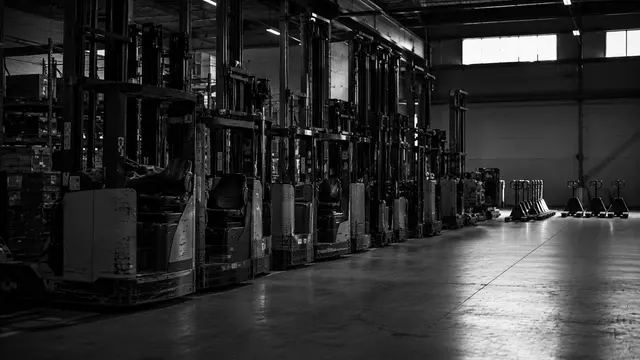
Every time I visit a warehouse and the conversation turns to the forklift fleet, I hear roughly the same thing. "Those trucks are used all day." Or: "Every machine here is essential."
The utilisation rate of your MHE fleet is the percentage of available time that a forklift or other material handling equipment is actually running, calculated as the number of operating hours divided by the number of available hours per year.
That sounds logical. Certainly when you walk daily through a busy warehouse where equipment is constantly moving. Yet the hour meters often tell a very different story.
The calculation almost nobody makes
Let's take an organisation working a single shift. An employee works around 40 hours a week. Factoring in holidays, public holidays and other absence, a machine theoretically comes to around 40 hours × 50 weeks = 2,000 available hours per year.
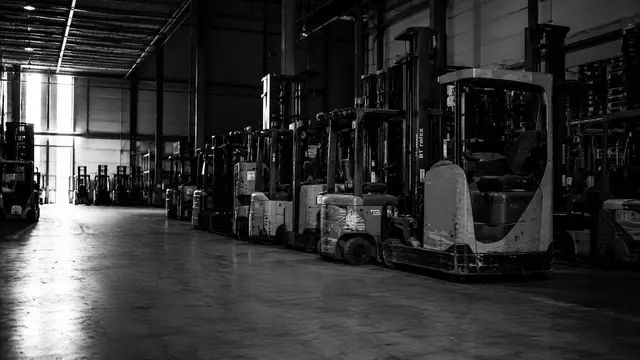
When I then look at the hour meter of a forklift, I regularly see machines running only 500 hours a year.
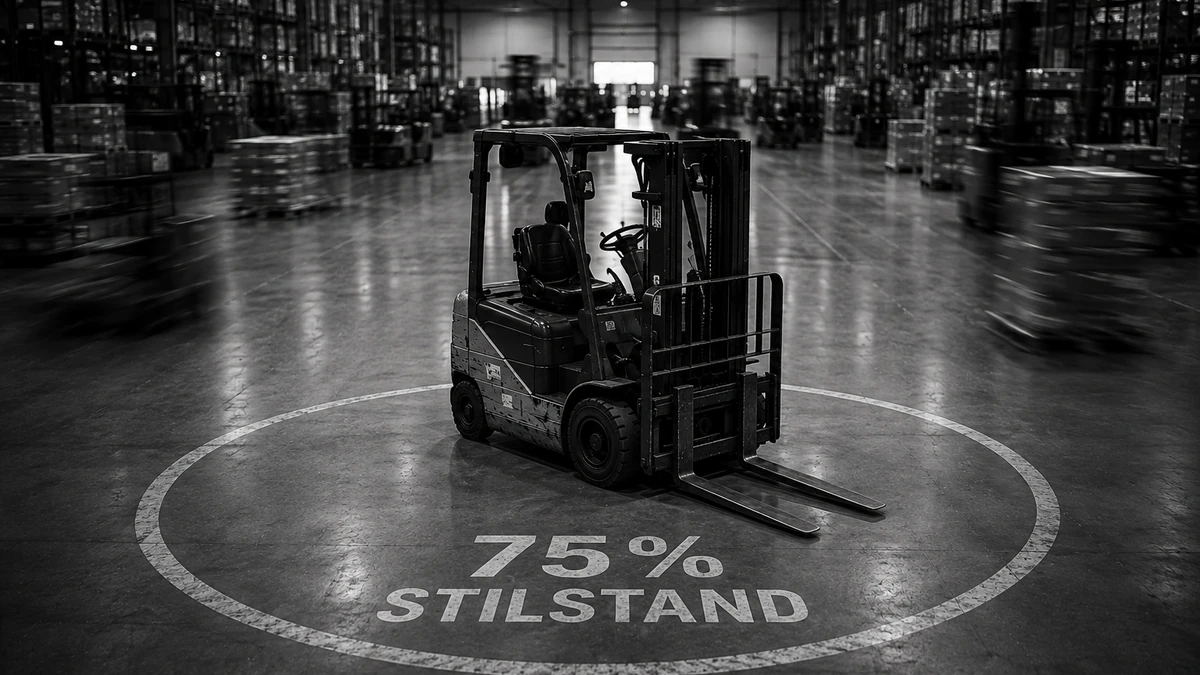
That does not mean the forklift is available 500 hours a year. It means the forklift is actually used only 25% of the available time. Or put differently: 75% of the time it stands still.
And those are not even the exceptions.
Some machines run far less
I regularly come across forklifts used only around 100 hours a year. Sometimes even less. Often these are machines with special attachments, or trucks that were once purchased for one specific customer or one particular process.
At the time that was probably a logical choice. But years later that machine is still there. Just in case.
Let me be clear about this: a truck running 100 hours a year does not really belong in a professional organisation. Not because the machine has no value, but because there is almost always a smarter solution that enables the same task without letting an entire machine sit out the year.
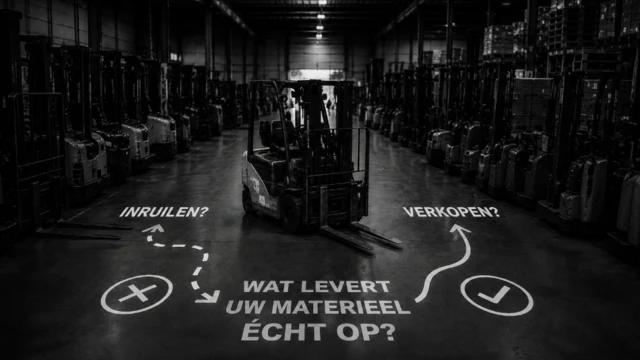
The most expensive forklift is often the one doing nothing
Let's make a simple calculation. A full operational lease on a specialist forklift quickly costs around €1,300 per month. That is €15,600 per year.
And if that truck is then used only 100 hours a year? Then simply having that machine available already costs €156 per operating hour. And we have not driven a single metre yet.
Then the operator is added
An experienced logistics employee quickly costs an organisation around €50,000 per year. At roughly 2,000 working hours, that comes down to about €25 per hour worked. Use that specialist truck for one hour, and the bill looks like this:
And that excludes electricity, damage, internal administration and any downtime for maintenance.
The question is then no longer "what does this forklift cost?" but: does the task it performs actually still deliver enough value?
Calculate the utilisation rate of your own fleet
The formula is simple:
Utilisation rate (%) = operating hours per year ÷ 2,000 × 100
| Operating hours per year | Utilisation rate |
|---|---|
| 100 hours | 5% |
| 250 hours | 12.5% |
| 500 hours | 25% |
| 1,000 hours | 50% |
| 1,500 hours | 75% |
| 2,000 hours | 100% |
Working two or three shifts? Then multiply the 2,000 hours by the number of shifts. The outcome remains just as confronting.
Smart solutions for that one specialist truck
This is the part that often gets skipped. A low utilisation rate does not automatically mean the machine has to go. Far more often it means the machine can be deployed differently.
A few directions that work well in practice:
- Move the attachment to a standard truck. Many specialist tasks are not in the truck itself, but in the attachment. With a quick-change system, that same clamp, rotator or fork positioner can often be fitted to a regular forklift. One machine then does the work of two.
- Choose a more flexible base model. When replacing equipment, the question is rarely just which truck replaces this one, but above all which truck can handle this task and the tasks of another machine. Two half-used machines then become one well-utilised machine.
- Cluster tasks in the planning. When the specialist work comes in spread across the week, the machine sits idle the rest of the time. Bundling those tasks into fixed moments creates room to deploy the machine more broadly, or to stop owning it altogether.
- Rent instead of own. For a task that occurs a few times a year, short-term rental is almost always cheaper than an annual contract. The calculation above shows exactly where that tipping point lies.
- Share between locations. Organisations with multiple sites sometimes have the same rarely used machine at every location, while one machine with a well-considered schedule would be more than enough.
The common thread: look first at what the machine needs to do, not at what is standing there now.
How many trucks do you really need?
This is exactly the question that often surfaces during an independent analysis. Not every truck has to go. Sometimes it turns out machines can simply be deployed more intelligently. Perhaps two specialist trucks can be replaced by one more flexible model. Perhaps processes can be planned differently. Perhaps a special attachment can be used on another machine. How many forklifts a warehouse really needs is rarely the same number as the one standing there now.
Or perhaps it is indeed sensible to keep that extra truck. But then it is a conscious choice, and not because it has always been there.
Idle time is not free
In many organisations the focus is mainly on the purchase price of equipment. Far less attention goes to the cost of machines that remain available for years without actually adding value. That is also exactly why a large fleet is not always an advantage.
That is precisely where surprisingly large savings often lie. Not by working harder, but by looking more critically at what the fleet actually does.
More than just numbers
An hour meter never tells the whole story. There can be good reasons why a machine runs little. Think of peak loads, safety, continuity or a strategic reserve.
Yet low deployment is still a signal to look further. Not with the question of how to fill this truck up more, but with the question: is this still the best solution for our operation?
That is exactly where an independent perspective can make the difference. Not from a supplier or a brand, but from the operation as a whole.
In short: how to measure it yourself
The hour meter on the machine counts every hour since the truck was new. So that figure says nothing about what it did over the past year. To determine the utilisation rate, you need the difference between two readings.
- Note the reading at the start of the month. For example on 1 March: 4,180 hours.
- Note the reading at the end of that same month. On 1 April: 4,215 hours.
- Subtract the two readings. 4,215 − 4,180 = 35 operating hours that month.
- Extrapolate to a full year. 35 × 12 = 420 operating hours per year.
- Calculate the utilisation rate. 420 ÷ 2,000 × 100 = 21%.
So this machine runs roughly a fifth of the time it is available.
One month does remain a snapshot. If your measurement happens to fall in a holiday period or in a peak week, the outcome shifts considerably. Measure three months in a row and take the average, and the picture already becomes a lot more reliable. Measure every month for twelve months, and you simply know for certain while also mapping the seasonal patterns.
The rule of thumb is simple: the more often you measure, the closer you get to the actual utilisation rate. And the less room remains for the assumption that a machine really is used all day.
Just start this week. Note the reading per machine with the date alongside it, and repeat it a month later. Chances are you will pause at at least one truck.
Frequently asked questions
What is a normal utilisation rate for a forklift?
There is no hard standard for this, but in single-shift operations you often see 25% to 50% in practice. If the utilisation rate is structurally below 15%, that is a clear signal to review the deployment of that machine.
How do you calculate the cost per operating hour of a forklift?
Divide the annual cost of the machine, including lease or depreciation, maintenance and inspections, by the number of operating hours per year. A machine costing €15,600 per year that runs 100 hours therefore costs €156 per operating hour, excluding the operator.
Should I get rid of a forklift that runs very little?
Not by definition. There can be good reasons, such as peak capacity, safety or continuity. There are often smarter alternatives too: moving the attachment to a standard truck, clustering tasks, renting for occasional use or sharing machines between sites.
How do I measure how many hours my forklift runs per year?
The hour meter shows the total since the machine was new, so on its own it tells you little. Note the reading at the start and end of a month, subtract them and multiply by twelve. Repeat that measurement for a few months for a more reliable picture. On newer trucks the operating hours are often also available in the fleet management system or in your supplier reports.

Sjef Kerkvliet is the founder of OctaFlow and has more than 15 years of experience in intralogistics, warehouse optimisation and internal transport. Drawing on his hands-on experience, he helps organisations with questions around goods flows, process improvement, warehouse layout, automation and operational efficiency.
Want to talk about your operation?
A logistics or operational challenge? OctaFlow is happy to think along. No fuss, just a good conversation.