
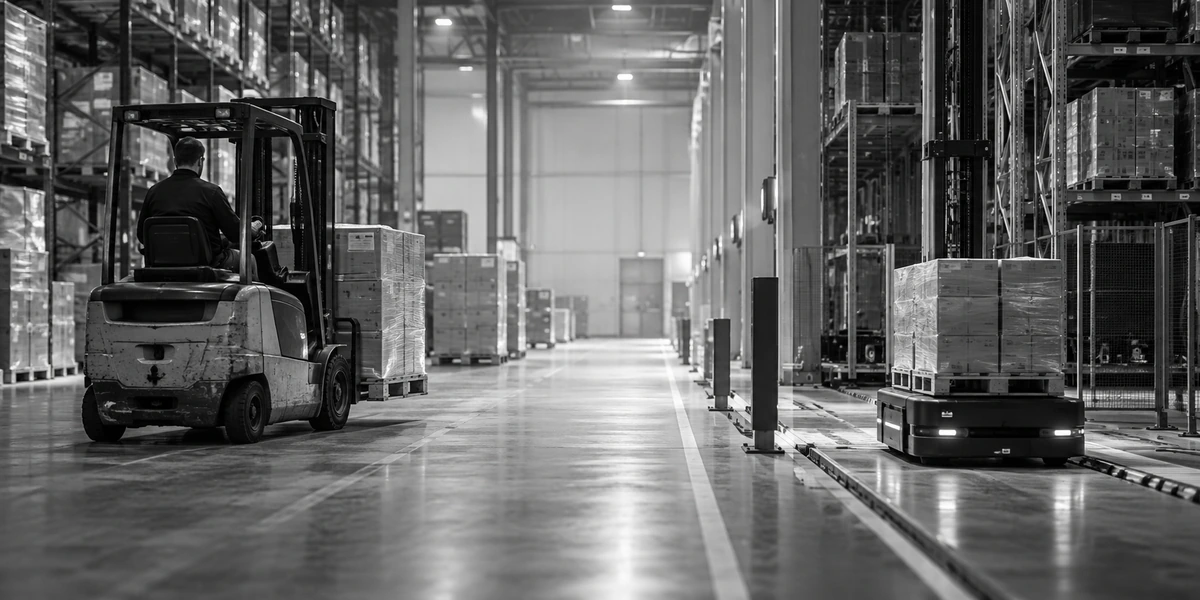
The technology for logistics automation is moving faster than most organisations adapt their processes. That creates an odd situation: a process written off two years ago as impossible to automate may well be within reach today, without anything about that process having changed.
Automating internal transport means that movements within your own walls, from production line to buffer and from buffer to dispatch, are carried out by AGVs, AMRs or fixed transport systems instead of by a driver on a forklift. The automation boundary is the point at which that becomes technically and economically feasible. That boundary is not fixed: it shifts with every generation of technology.
So the question has long stopped being whether internal transport can ever be automated. The question is when your specific process is up, and how you notice that the moment has arrived.
The boundary shifts, your process does not
Take an internal transport process that for years carried too much product variation for an AGV. The conclusion at the time was fair: not technically feasible. Then navigation grew more accurate, sensors improved, the software learned to recognise more kinds of load, and interaction with people on the floor became safer.
The product variation is exactly the same. The process has not changed. What changed is what the technology can handle.
That principle reaches further than internal transport alone. Automated stacking and palletising, shuttle and crane systems in storage, automatic wrapping, labelling and measuring, machine vision for inspection and sorting: on each of those fronts a group of processes regularly comes within reach that was out of reach a year earlier.
The consequence is uncomfortable but simple. An automation study is never finished for good. What falls away today can be back on the table in two years.
Four forces pushing the same way
None of these four developments is new in itself. What is new is that they occur together and reinforce each other.
People are getting scarcer
The work is there. The people to do it, less and less so, certainly for physical work in shifts.
People are getting more expensive
Wages, absence, agency staff and turnover together weigh ever heavier on the cost per hour.
The technology is maturing
What was a pilot five years ago runs today as daily practice in production.
Safety weighs heavier
Healthy work is no longer a side issue but a condition, and the requirements keep tightening.
In the Netherlands the first point is not a feeling but a demographic fact. In its sector analysis for transport and logistics, ABN AMRO finds that over the coming years more people will leave the sector than enter it, particularly in operational roles. Forklift drivers are named explicitly, alongside order pickers, loaders and unloaders, and planners. This is not a dip that passes on its own, but a shift that keeps running.
The sector is visibly responding. In the annual study by MHI and Deloitte among five hundred supply chain professionals, attracting and retaining people tops the list of challenges, named by 58 percent. In that same study, 56 percent report that their investment in technology and automation is going up.
The sum is no longer only about saving labour
Automation was long approached as a simple calculation: what does the system cost, how many labour hours does it save, and when have you earned it back. That question stays relevant, because a solution has to be economically sound. But anyone who limits the business case to that leaves most of the value out of view.
What is an unfilled vacancy worth to you? What does absence cost, what does turnover cost, and what does it cost when you cannot expand a process because you simply cannot find the people? What is more stable output worth, or the ability to handle more volume in three years without hiring proportionally more people?
Safety belongs in that same sum, and the Dutch figures are more concrete than many people think. In the workplace accident monitor of the Netherlands Labour Authority, the forklift is involved in roughly six percent of all notifiable workplace accidents, and the pallet truck in another six percent.
There is also a connection that leads straight back to the first point. Agency workers make up four percent of everyone at work, yet are involved in eighteen percent of workplace accidents. Absorbing a labour shortage with a constantly changing pool of hired staff therefore buys you added risk. An automated step is a step where nobody has to stand under, beside or behind anything, and where induction is no longer a safety question.
What automation asks of your process
When an organisation says a process cannot be automated, there is usually a good reason behind it. A system only works when the environment around it is right, and those requirements are real.
But there is a distinction hidden in them that is easy to miss: not every condition is equally fixed.
What you can change yourself
- The sequence and setup of the process
- How goods are presented and stored
- The quality and reliability of your data
- Floor, space and infrastructure
- Work instructions and standardisation
What is fixed for now
- The variation in the product itself
- What the customer asks for and delivers
- Seasonal peaks in demand
- The existing building and its height
- Technology that simply does not exist yet
The left column is a choice. The right column is a given, and changes only through time or through the market.
That changes the question you should be asking. Not: does our process meet every condition for automation? But: which conditions can we solve ourselves, which do we have to accept, and which will probably be solved for us by the technology?
That is not wordplay. You do not have to wait until your whole operation is suitable. You need to know which constraint you can remove yourself and which one you have to wait out.
From one large day shift to small teams around the clock
Something else is often underestimated. Automation changes not only how the work is done, but when.
The bar is the full day, the coloured part is when work happens, and the figures above are the people. The work does not disappear: it is done by fewer people, spread across a much larger part of the day.
A machine has no daily rhythm, no holidays and no employment agency. As more steps run automatically, staffing around the clock becomes economically more interesting. Not because nobody is needed any more, but because a smaller group of people can support a much larger part of the day. The role shifts from carrying out to monitoring, adjusting, maintaining and improving.
That the work does not simply vanish has by now been measured more widely. For the 2026 Global AI Jobs Barometer, PwC analysed almost a billion job adverts across 27 countries and sees a labour market splitting in two. Roles in which technology takes over the routine work and human judgement moves to the centre are growing roughly twice as fast in number, with 42 percent faster salary growth, than roles that technology mainly makes easier to perform.
That study is about AI and knowledge work, not forklifts, and that difference deserves to be taken seriously. But the underlying pattern is recognisable: where technology takes over the handling, judgement becomes more valuable. Translated to the floor, whoever moves pallets today monitors an automated transport zone tomorrow. The muscle is replaced, the knowledge becomes more important.
The shift is gradual, not a switch
There is no moment at which everything flips. What you see is a shift that moves a little further year after year, with conventional and automated work coexisting for a long time yet.
An indicative picture of the direction in which the balance between manual and automated work is moving. Not a forecast of exact percentages.
That picture is confirmed from two sides. On the one hand it is clearly accelerating: in the MHI and Deloitte study, 39 percent name robotics and automation a technology with significant or greater impact, sixteen percentage points more than the year before. On the other hand, ABN AMRO is sober about what that solves. Automation, mechanisation and digitalisation can ease the shortage in part, they say, but human labour remains indispensable in daily operations for years to come.
Both pictures are true at once. A great deal is being automated, and for most organisations the end point is not an empty factory.
Automation is not a switch, it is a cycle
Because the boundary keeps moving, automation should not be a one-off project but a recurring question. In practice that comes down to seven steps you work through periodically.
What
Which part of the process qualifies? Not everything at once, but one piece.
Why
Hours, cost, capacity or safety. Without a goal there is no measurable result.
Possible yet?
Does the technology exist, and is it genuinely running in production somewhere?
Conditions
What has to change, and what does that cost in time and money?
Business case
Cost against return, including the effect on the operation.
Feasible?
Yes: on to seven. No: keep an eye on the market.
Implement
Carry it out, embed it, and bring your people along.
Then back to 1. Every round something has changed in the technology, the volumes or the costs.
The answer at step six is more often „not yet” than „no”. That is not a delay but an outcome, provided you record why it cannot be done yet and when you will look again.
Two tracks at once, and that is no contradiction
The odd thing about this subject is that it is often presented as a choice between two camps. As if you have to pick between investing conventionally or committing to automation. In practice those two tracks run alongside each other perfectly well.
Carry on buying forklifts, reach trucks and other equipment exactly as you are used to, because your operation has to run today and will for years yet. Set the study alongside it: which processes lend themselves to automation, which conditions come with them, and what is the business case. Automation is a route measured in years, so let it gradually take work away from the conventional way rather than waiting until everything can go at once.
You can buy a forklift today and at the same time investigate whether the same transport can be done by an AMR in five years. That is not a contradiction, that is looking ahead.
The risk lies in no longer looking
There is nothing wrong with concluding that a process should not be automated. Sometimes doing it by hand is simply the best solution. The problem only arises when an organisation stops investigating why.
Meanwhile technology gets cheaper, more flexible and easier to integrate, and suppliers gain experience. Anyone not following that falls behind without noticing. Not because a competitor automates their entire operation tomorrow, but because they may automate one process that you still do entirely with people. And then another.
The hardest competitor is not necessarily the existing one. A new entrant has no building already standing, no machines already installed and no processes that were once set up for a reason. They do not have to work out how to automate an existing process; they can design the process around the technology that exists today. That is a considerably stronger position, and it does not even require more technical knowledge.
The question beneath the question
Automation therefore does not start with the technology. An AGV, a robot or an automated storage system is ultimately a means. The real question starts with the operation: where does dependence on people sit, where is the physical strain, where do errors arise, which processes only run because enough people happen to be available, and which condition is holding automation back today?
Perhaps the answer is that automating now is unwise. But during that study you sometimes discover something more interesting: that the boundary has moved, and that exactly the process you said could not be done at your site two years ago is up next after all.
So the most important question is probably not whether you should automate. It is whether you know which part of your operation becomes automatable next.
Research this article draws on
Netherlands Labour Authority, Monitor Arbeidsongevallen 2024. On the share of forklifts and pallet trucks in notifiable workplace accidents, and on the raised risk among agency workers.
ABN AMRO, Personeel blijft voorlopig schaars. Sector analysis of the structural shortage in transport and logistics, and of what automation does and does not solve.
MHI and Deloitte, Annual Industry Report 2026. Annual study among five hundred supply chain professionals on the advance of automation and robotics and the challenges around people.
PwC, 2026 Global AI Jobs Barometer. Analysis of almost a billion job adverts across 27 countries on how technology changes roles rather than simply removing them.
Frequently asked questions
When is automating internal transport worthwhile?
It depends on three things: how many movements you save, how predictable those movements are, and what an hour of human effort really costs you including absence, agency staff and turnover. A viable case usually arises with repeatable transport along fixed routes with enough volume, not with occasional or highly variable work.
Can my process be automated if there is a lot of product variation?
More often than a few years ago. Better navigation, more accurate sensors and machine vision have considerably increased the amount of variation a system can handle. The more important question is which variation comes from the product itself and which comes from the way you present it. The latter you can change yourself.
Does automation mean people have to go?
Not automatically. What almost always changes is the role: from carrying out to monitoring, adjusting and solving. In an analysis of almost a billion job adverts, PwC sees that roles in which technology takes over the routine work and human judgement moves to the centre are in fact growing faster. That shift does call for different skills, and training belongs with it.
Should I stop investing in forklifts now?
No. Your operation has to run today and will for years yet. The sensible route is two tracks at once: keep investing conventionally as you are used to, and investigate in parallel which processes lend themselves to automation. Automation is measured in years, so that study starts earlier than the investment.
How often should I look at automation again?
Annually is a workable rhythm. The technology shifts step by step, and each step can bring a group of processes within reach that was out of reach before. The answer that it cannot be done yet is only useful when it records why not, and when you will look again.

Sjef Kerkvliet is the founder of OctaFlow and has more than 15 years of experience in intralogistics, warehouse optimisation and internal transport. Drawing on his hands-on experience, he helps organisations with questions around goods flows, process improvement, warehouse layout, automation and operational efficiency.
Want to talk about your operation?
A logistics or operational challenge? OctaFlow is happy to think along. No fuss, just a good conversation.
Warehouse layout doesn't start with racking, it starts with understanding the logistics flow
Warehouse layout doesn't start with available space, it starts with the logistics flow. Why installing racking without understanding the process leads to hidden inefficiency.
What is warehouse optimisation? And why it's often about something else
Many people think of automation or extra equipment. Yet the biggest gains usually lie in the processes that already exist.
What does a warehouse scan actually deliver?
The bottlenecks are often already known. A warehouse scan reveals the bigger picture and surfaces improvement opportunities that went unnoticed before.
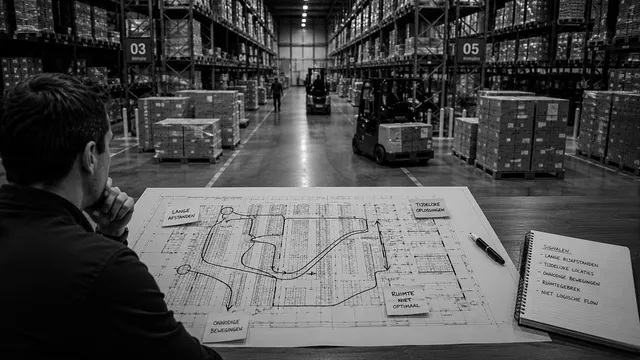
How do you recognise an outdated warehouse layout?
Long travel distances, lack of space and temporary locations that became permanent: often the layout isn't wrong, the operation simply changed faster than the setup.
Why not all waste is visible
Damage and breakdowns stand out. But ten employees losing minutes a day to waiting and searching go unnoticed. And that is what costs more.
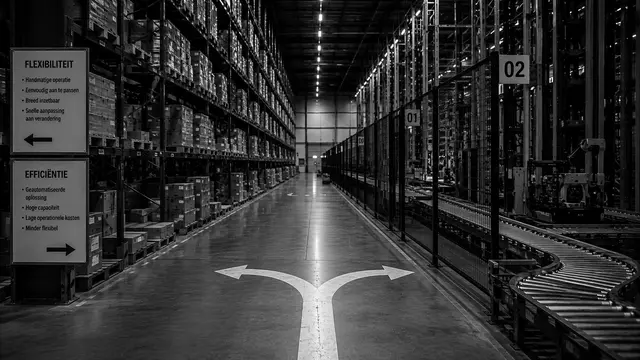
Why efficiency sometimes comes at the cost of flexibility
Every choice sits somewhere between maximum efficiency and maximum flexibility. The best choice depends on where your operation needs to be in five years.
Why a warehouse is often designed for a company that no longer exists
Lack of space, capacity, ageing equipment. Yet the key question is rarely asked: does the layout still fit the company of today?
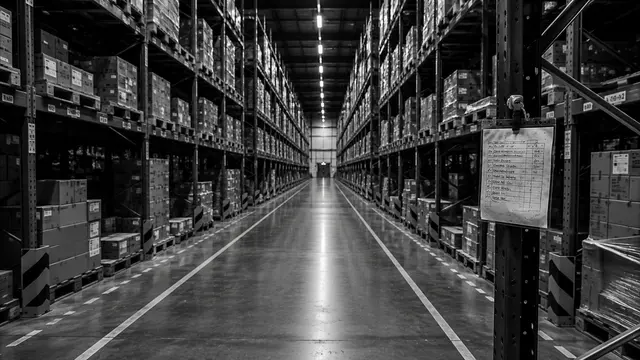
Why a warehouse is often smarter than its processes
Personal spreadsheets, handwritten lists and informal agreements: the shop floor plugs the gaps in the process every day, often without anyone noticing.
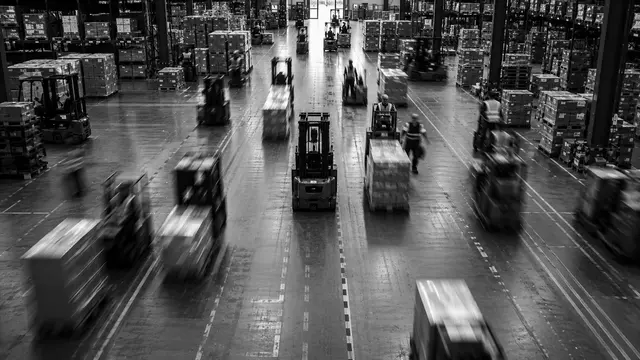
Why a busy warehouse isn't always an efficient warehouse
Forklifts dash back and forth and everyone is on the move. But busyness says little about how much value is actually being added.