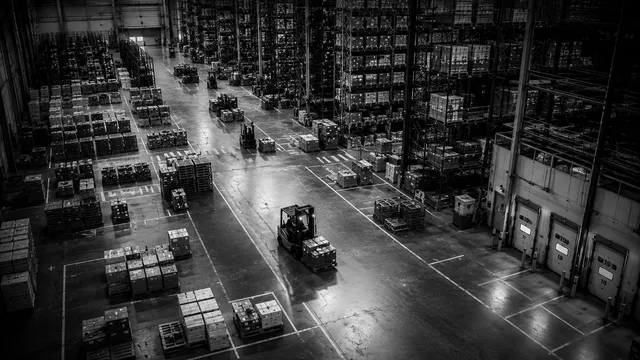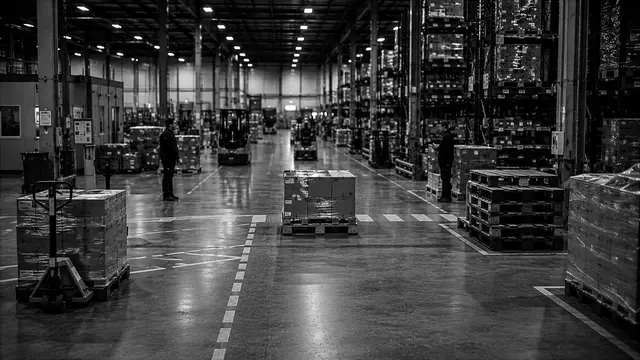
Block stacking has been one of the most space-efficient ways to store pallets for decades. No racking, no expensive installations, and virtually every square metre of floor can be used for storage.
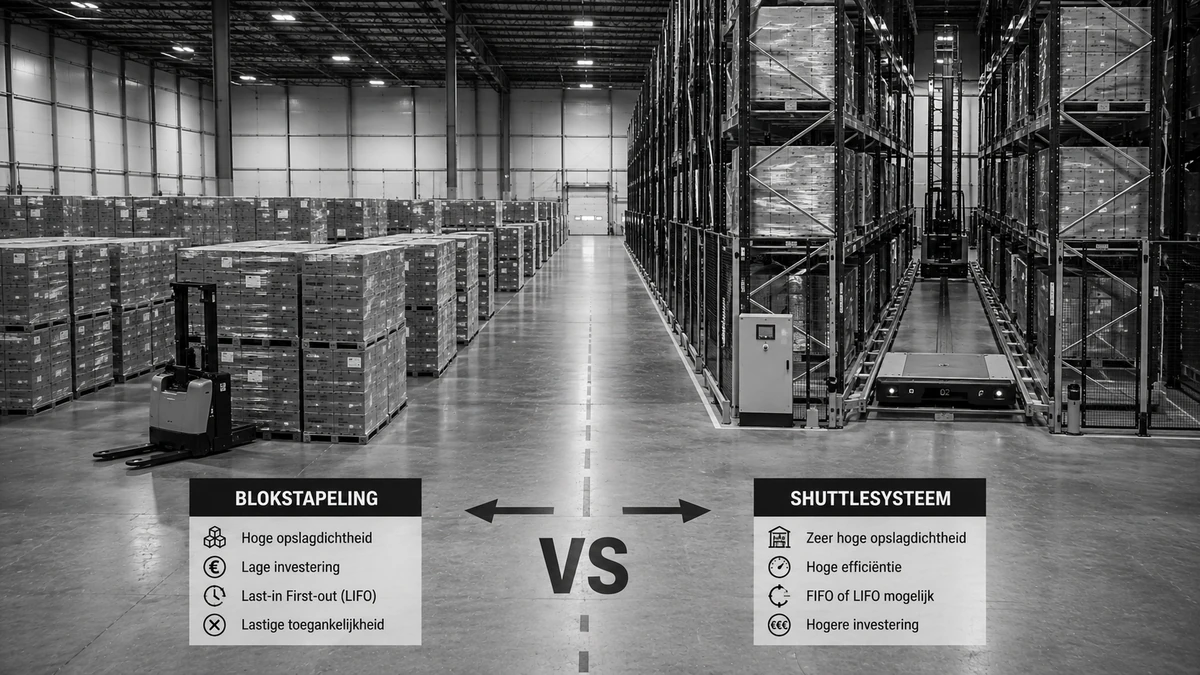
Block stacking is a storage method in which pallets are stacked directly on top of each other, without a racking system. A pallet shuttle system combines the high storage density of block stacking with an electric shuttle that moves pallets within a racking channel, making both FIFO and LIFO possible.
Yet more and more companies are now choosing a pallet shuttle system. Not because block stacking is bad, but because logistics requirements are changing.
Why block stacking is so popular
The advantages are clear: you have no investment in racking, you use virtually the entire floor area, and with a limited number of articles at high volumes you can store an enormous number of pallets. For buffer storage or seasonal stock, block stacking is therefore often still an excellent solution. But as soon as stock becomes more dynamic, the limitations start to show.
The downside of block stacking
With block stacking, accessibility always remains a challenge: need a pallet at the bottom of a stack? Then the pallets on top have to be moved first, which makes FIFO difficult to carry out. Block stacking also places demands on the packaging, pallet quality and floor loading, after all, the bottom pallet carries the weight of every pallet above it. For a limited range with many pallets per article, that is often not a problem, but as the number of SKUs grows, so does the amount of extra handling.
The middle step: the pallet shuttle
To retain the storage density of block stacking while improving accessibility, we increasingly see pallet shuttles. With this system, an electric shuttle drives independently through a storage channel and transports pallets to the desired position. The reach truck places the shuttle at the start of a channel and then moves it to the next channel when needed, so the forklift no longer has to drive into the racking channel itself. That delivers a much higher storage density than traditional pallet racking, fewer forklift movements, less chance of damage to racking, higher safety and faster storage and retrieval of pallets. Depending on the layout, both FIFO and LIFO are easily possible, something that is often difficult or even impossible with block stacking.
The next step: four-way shuttles
Where the traditional pallet shuttle is still moved between storage channels by a reach truck, the development has now gone a step further. Four-way shuttles form a fully automated storage system: via lifts, the shuttles move independently between different floors and storage channels. They travel both lengthwise and widthwise through the racking block and bring pallets to the right location fully automatically. The result is a system that combines the storage density of a compact warehouse with a high degree of flexibility and automation: you make use of the full height and depth of the warehouse, virtually every pallet remains accessible, FIFO is easy to achieve and the amount of forklift traffic drops sharply. Because extra shuttles can be added relatively easily, capacity also grows along with demand. For companies with a lot of pallet movements and high space utilisation, that can deliver an enormous efficiency gain.
The three options side by side
| Characteristic | Block stacking | Pallet shuttle | Four-way shuttle |
|---|---|---|---|
| Storage density | High | High | High |
| FIFO possible | Barely (virtually always LIFO) | Yes | Yes |
| Investment | Low | Medium | High |
| Automation level | None | Partial | Full |
| Forklift movements | Many | Fewer | Minimal |
| Best suited for | Few SKUs, many pallets per SKU | Growing SKU count, FIFO needed | High throughput, full automation wanted |
Does this mean block stacking is a thing of the past?
Certainly not. In fact, for many companies block stacking is still the most logical and cheapest solution. Do you have a limited number of articles, many pallets per SKU and little need for direct pallet access, then block stacking remains hard to beat, especially since a shuttle system requires a much larger investment. So the question is not which technology is the most modern, but which technology best fits your operation.
The choice doesn't start with the technology
I regularly see companies look straight at the newest automation solutions. But automation is not a goal in itself, it is a means. The first question should therefore never be "should we buy a shuttle system?", but rather the points below:
Before you choose, you want an answer to:
- How many SKUs do we store?
- How many pallets do we have on average per SKU?
- How important is FIFO for our products?
- How many pallet movements do we have per day?
- Do we expect to keep growing in the coming years?
- Is space or labour our biggest constraint?
Only once those questions have been answered does it become clear whether block stacking is still the smartest solution, or whether a pallet shuttle or fully automated four-way shuttle system ultimately delivers more return. Because the best warehouse layout is rarely the most expensive, and rarely the cheapest either. It is the solution that best fits the way your goods actually move through the warehouse.
Frequently asked questions
What is the difference between block stacking and a pallet shuttle system?
With block stacking, pallets are stacked directly on top of each other without racking, so the bottom pallets only become accessible once the ones on top have been moved. A pallet shuttle system uses an electric shuttle within a racking channel, so every pallet remains individually accessible and both FIFO and LIFO are possible.
When is block stacking still the best choice?
With a limited number of articles and many pallets per SKU, little need for direct access to individual pallets, and when keeping the investment as low as possible matters most. For buffer storage and seasonal stock, block stacking is often still the most logical solution.
What is a four-way shuttle system?
A four-way shuttle system is a fully automated storage system in which shuttles move independently between floors and storage channels via lifts, travelling both lengthwise and widthwise, and bring pallets automatically to the right location.
Is FIFO possible with block stacking?
Barely. Because the bottom pallets only become accessible once the pallets on top have been moved, block stacking in practice almost always works on a LIFO basis. For strict FIFO, a pallet shuttle system or racking system is a better choice.

Sjef Kerkvliet is the founder of OctaFlow and has more than 15 years of experience in intralogistics, warehouse optimisation and internal transport. Drawing on his hands-on experience, he helps organisations with questions around goods flows, process improvement, warehouse layout, automation and operational efficiency.
Want to talk about your operation?
A logistics or operational challenge? OctaFlow is happy to think along. No fuss, just a good conversation.